Global Surveillance and Where PJ.2.1 Is Circulating
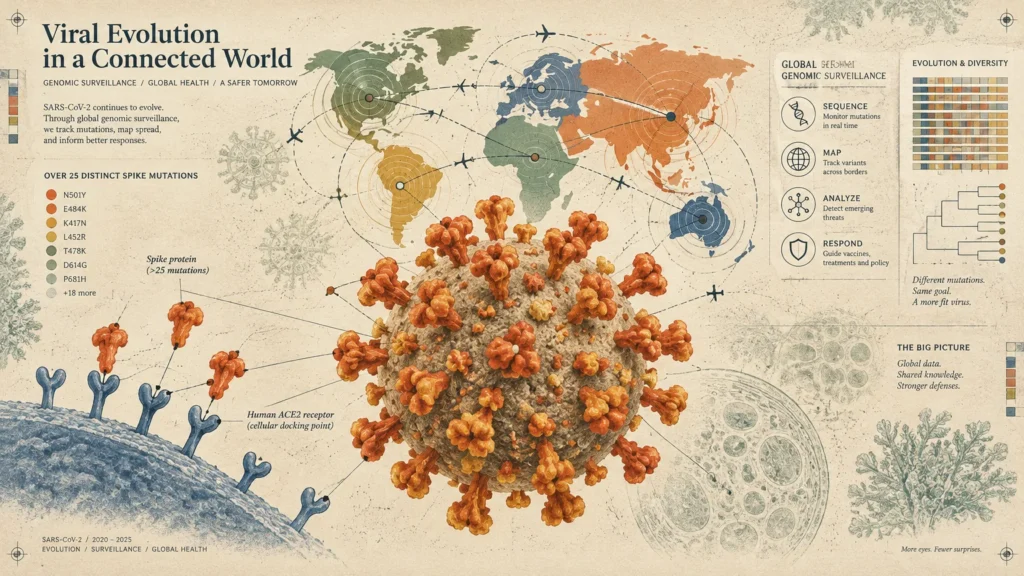
Since its May 2026 detection, genomic surveillance has tracked PJ.2.1 across eight countries spanning four continents as of November 2026. Documented detections include Canada, the United States, France, Spain, Singapore, Israel, Australia, and New Zealand.
Within Canada, public health laboratories identified cases in Ontario, Alberta, British Columbia, and New Brunswick. Ontario saw rapid growth, where Public Health Ontario reported on November 2, 2026, that PJ.2.1 climbed from 1.1 percent of sequenced samples in July to 25.2 percent by mid-October.
Between September 20 and October 17, 2026, PJ.2.1 accounted for 132 of 523 sequenced cases in Ontario, making it the province’s most commonly detected lineage. Health officials note that sequenced swabs come from specific testing pools and may not mirror every community infection.
In the United States, surveillance teams first logged PJ.2.1 in New York City on June 30, 2026. Subsequent detections appeared in California, Arizona, New Jersey, Virginia, North Carolina, Missouri, Oklahoma, Colorado, and Florida.
Even with that geographic reach, PJ.2.1 has not overtaken dominant variants everywhere. Late August 2026 data cited by Nebraska Medicine from the Centers for Disease Control and Prevention showed SW.2 at 21 percent, XFG.1.1 at 16 percent, and RW.1.1 at 9 percent nationally.
Across Europe, XFG remains a major competitor alongside PJ.2.1’s rise. Mid-October 2026 data from the European Centre for Disease Prevention and Control showed PJ.2.1’s family at 20 percent of sequenced French viruses versus 54 percent for XFG, while Spain documented sustained local transmission chains.
Meanwhile, the UK Health Security Agency noted that XFG stayed dominant in autumn 2026 as test positivity neared 7 percent and hospital admissions rose roughly 50 percent in September alongside typical seasonal circulation. You can follow international lineage shifts through World Health Organization variant tracking updates.
On the July 27, 2026 tracking list, PJ.2.1 was not yet named a Variant of Interest or Variant Under Monitoring; JN.1 remained the active Variant of Interest alongside four Variants Under Monitoring. Still, on October 27, 2026, the agency’s vaccine advisory group requested PJ.2.1 data before its December meeting.
Risk Factors and Current Evidence on Disease Severity
Early epidemiological data analyzed by Hoffmann and colleagues indicate that PJ.2.1 has mainly infected adults aged 60 years and older. That age pattern mirrors most recent circulating lineages and contrasts with BA.3.2, which preferentially affected children aged 9 and under.
Age alone does not tell the whole story when you assess personal vulnerability. Older adults, people with chronic heart, lung, or metabolic conditions, individuals with severe obesity, pregnant people, and immunocompromised patients face higher stakes from any SARS-CoV-2 infection.
Importantly, researchers and public health authorities stress that faster cell entry in laboratory assays does not prove faster person-to-person spread in real life. Multiple factors—including prior immunity, seasonal indoor crowding, and masking habits—shape how quickly a variant moves through neighborhoods.
As of November 2026, clinical evidence does not establish that PJ.2.1 causes harsher illness, higher hospitalization rates, or greater mortality than other circulating Omicron sublineages. Monitoring continues closely, so staying alert to your own risk profile remains the smartest step you can take.