Waking up with a scratchy throat, body aches, or sudden fatigue leaves you wondering whether you caught a seasonal cold, the flu, or the spreading COVID-19 variant known as PJ.2.1. Health agencies report that PJ.2.1 mimics everyday respiratory bugs, making symptoms alone unreliable.
First identified in Ontario, Canada, in May 2026, this heavily mutated Omicron sublineage now circulates across eight countries on four continents. Understanding how PJ.2.1 behaves helps you test accurately, protect high-risk relatives, and act quickly if warning signs appear.
This guide explains what scientists know about PJ.2.1 transmission, diagnosis, 2026–2027 vaccines, and daily care; share these educational insights with your clinician before making medical decisions.
Understanding the PJ.2.1 Variant and How It Spreads
Where PJ.2.1 Came From and Why Its Spike Protein Matters
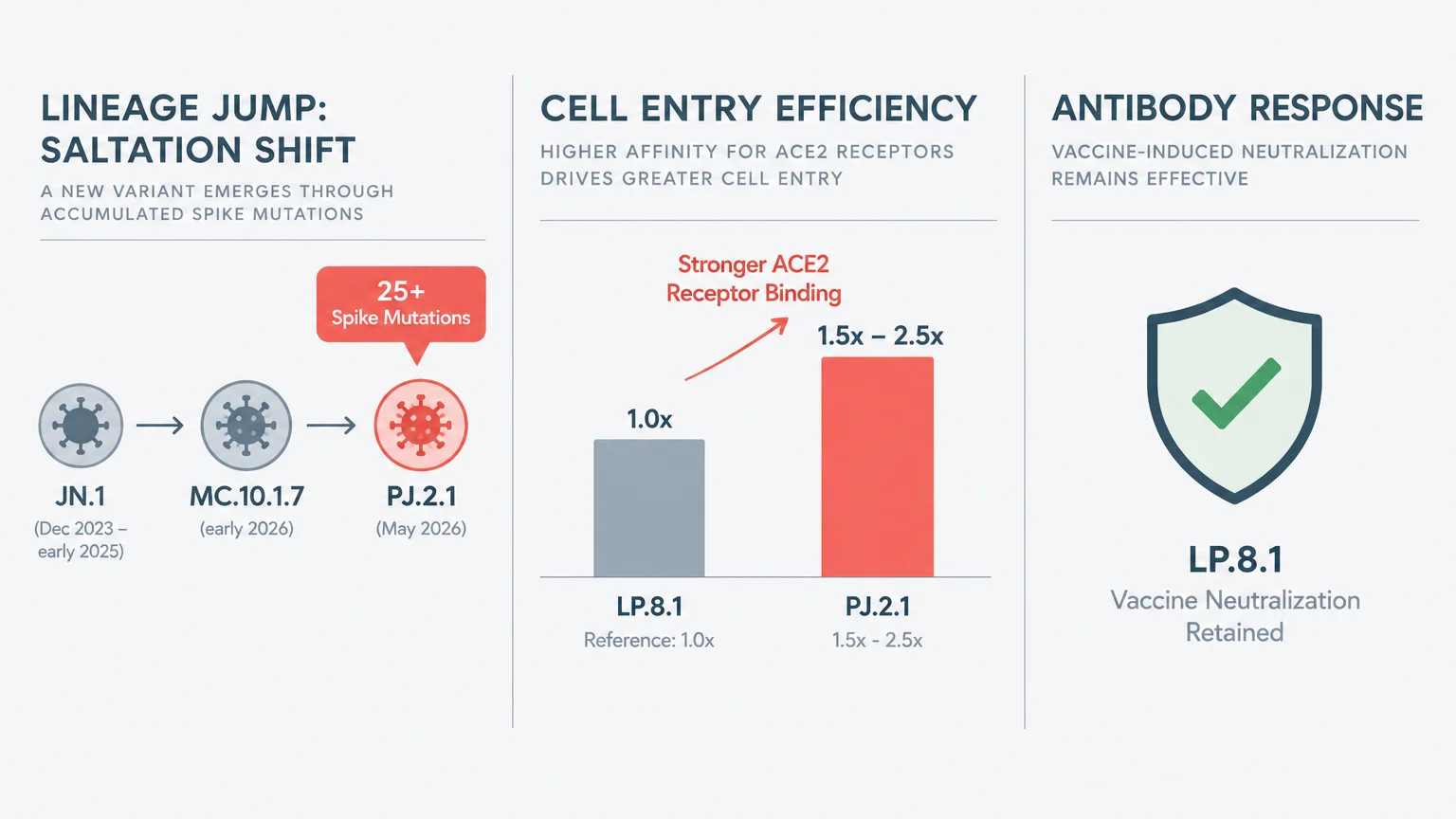
Researchers classify PJ.2.1 as an Omicron sublineage that descended from MC.10.1.7 within the broader JN.1 family, which circulated widely until May 2025. The earliest documented PJ.2.1 sample was collected in Ontario, Canada, on May 2, 2026.
According to findings published by Markus Hoffmann and colleagues in the Journal of Infection in October 2026, PJ.2.1 stands out as a saltation, or shift, variant. Unlike typical lineages that drift gradually, saltation variants accumulate sudden genetic leaps, likely during a persistent infection.
Because of this evolutionary jump, PJ.2.1 carries more than 25 mutations on its spike protein—the structure SARS-CoV-2 uses to latch onto your airway cells. That dense cluster of changes immediately drew attention from virologists tracking global viral evolution.
Laboratory pseudovirus experiments by Hoffmann and his team revealed that PJ.2.1 enters human cells roughly 1.5 to 2.5 times more efficiently than the LP.8.1 reference strain. Tests also showed weaker blocking by anti-ACE2 antibodies compared with NB.1.8.1, XFG, and BA.3.2.2.
Together, those laboratory signals point toward stronger binding to the human ACE2 receptor rather than dramatic escape from prior immunity. In fact, PJ.2.1 did not show heightened evasion of neutralizing antibodies from people who received an LP.8.1-adapted vaccine.
For you, this distinction offers reassuring context alongside sensible caution. While tighter receptor binding may help the virus enter cells in a lab dish, existing vaccine-trained antibodies still recognize and neutralize it in laboratory testing.