
The Science of Renal Stress and Metabolic Overload
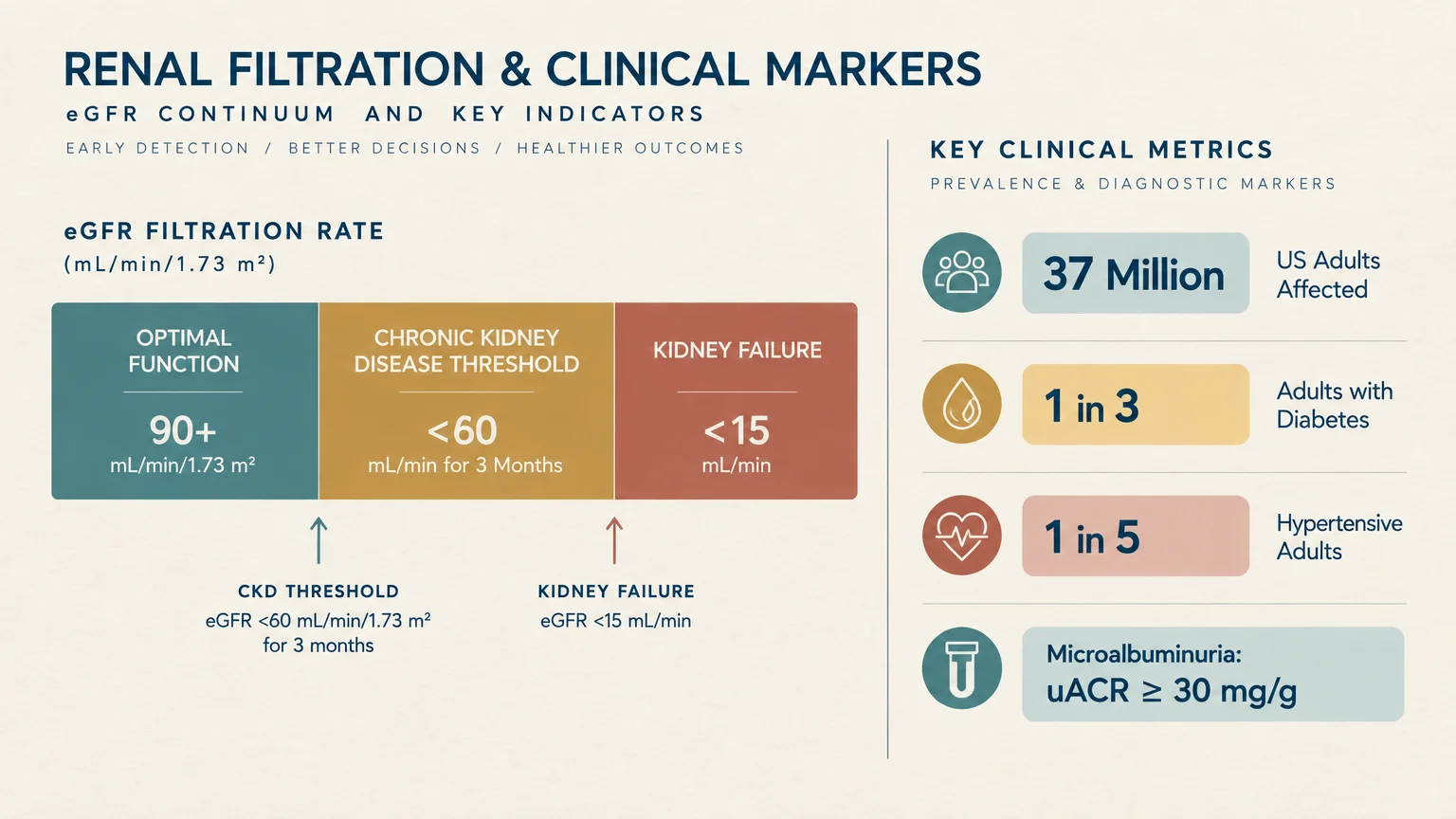
Chronic kidney disease impacts approximately 14 to 15 percent of American adults, totaling roughly 37 million people. Up to 90 percent of individuals living with early renal impairment do not realize they have it.
Metabolic conditions inflict the heaviest toll on your renal system over time. The Centers for Disease Control and Prevention notes that roughly one in three adults with diabetes suffers from chronic kidney disease.
Persistent high blood pressure degrades fragile glomerular capillaries, affecting one in five hypertensive adults. When vascular tension remains elevated, kidney filters harden and lose their ability to cleanse circulating blood effectively.
Clinicians monitor filtration efficiency by evaluating your estimated glomerular filtration rate, known as eGFR. An optimal eGFR measurement registers at 90 mL/min/1.73 m² or above.
A persistent eGFR reading under 60 for three months signals chronic kidney disease, while a score below 15 indicates end-stage failure. More than 830,000 Americans currently live with end-stage kidney disease requiring dialysis or transplantation.
Doctors also test for microalbuminuria using the urine albumin-to-creatinine ratio, or uACR. A sustained uACR reading of 30 mg/g or higher confirms that structural damage allows vital proteins to spill into urine.
Renal vulnerability increases with age, affecting 34 percent of adults over age 65. Disparities also exist; Black adults develop kidney failure at four times the rate of White adults, while Hispanic Americans face double the risk.








Leave a Reply