

Navigating healthcare costs in retirement requires clear insight into upcoming policy shifts, especially as Medicare premium adjustments directly impact your monthly household budget. Projections from the Medicare Trustees Report indicate that the standard Medicare Part B monthly premium will rise to approximately $209.50 in 2027, alongside an increase in the annual deductible to $292. Understanding how these changes intersect with your income is crucial because income surcharges operate on a strict two-year lookback period. Your 2025 income directly dictates your 2027 healthcare expenses through Income-Related Monthly Adjustment Amount brackets. Taking deliberate steps today helps you protect your retirement savings, optimize your preventative care strategies, and maintain financial peace of mind.
Understanding the 2027 Medicare Landscape and Rate Changes
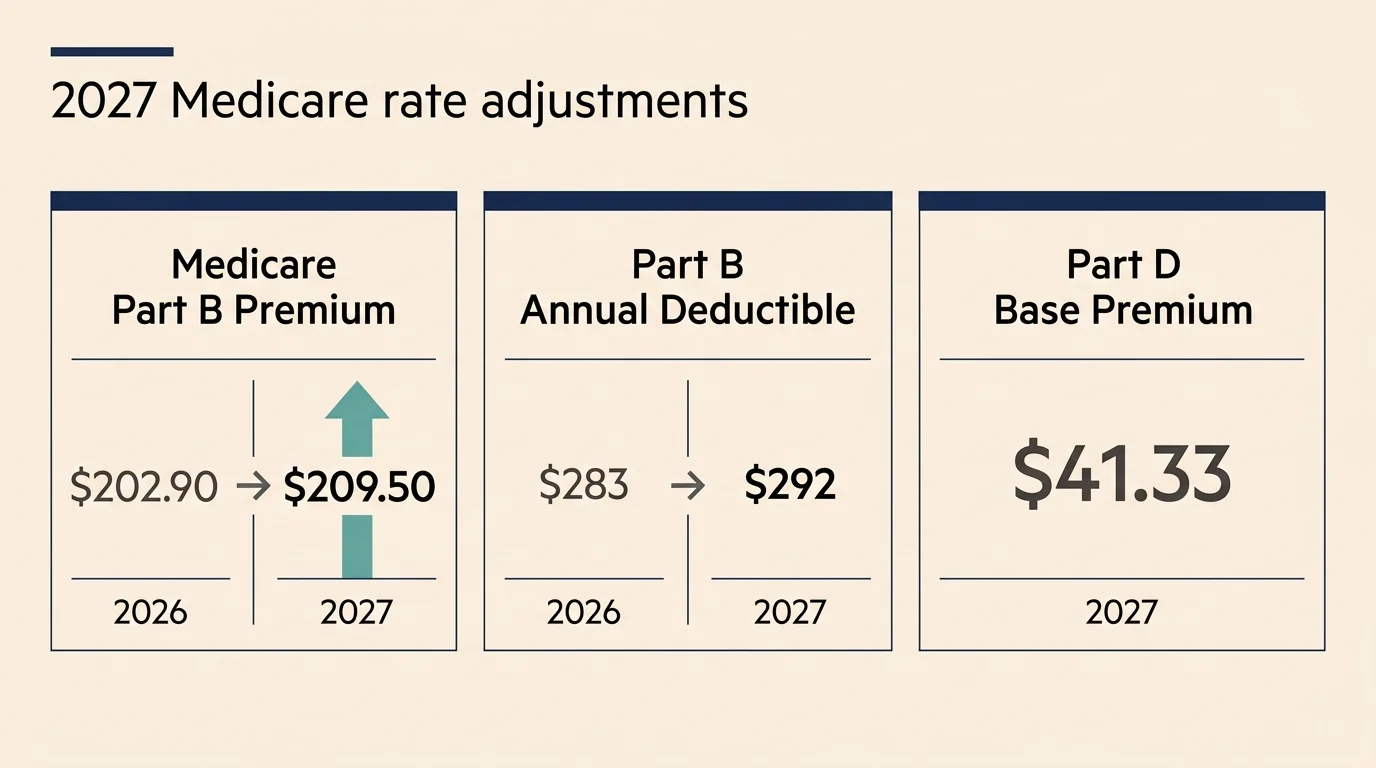
Healthcare financial planning requires foresight, particularly as administrative updates shape the Medicare cost landscape year after year. The Medicare Trustees Report projects that the standard Medicare Part B monthly premium will reach $209.50 in 2027. This figure represents a $6.60, or roughly 3.25 percent, increase from the confirmed 2026 monthly rate of $202.90. While official figures receive final confirmation from the Centers for Medicare & Medicaid Services each autumn, these reliable projections provide the essential baseline you need to map out your long-term wellness and healthcare expenditures today.
Beyond the monthly Part B premium, other essential out-of-pocket thresholds are shifting across the board. The Part B annual deductible is projected to rise to $292 in 2027, reflecting a $9 increase from $283 in 2026. This deductible applies to most outpatient medical services, doctor visits, physical therapy sessions, and preventive screenings before your coverage pays its full share. Simultaneously, the Part D base beneficiary premium for prescription drug coverage is projected at $41.33 per month. When you combine these base increases, managing your annual healthcare spend becomes an ongoing discipline that requires clear strategies rather than passive observation.
Understanding these foundational numbers gives you a distinct advantage when structuring your personal finances for retirement. Because medical inflation and general economic adjustments continuously alter the cost of clinical care, staying informed allows you to anticipate out-of-pocket shifts before they impact your checking account. By framing healthcare costs as an integral component of your broader lifestyle strategy, you position yourself to maintain consistent access to high-quality medical services while preserving your financial resilience over many years.
The 2025 Lookback Rule: How Your Current Income Sets 2027 Premiums
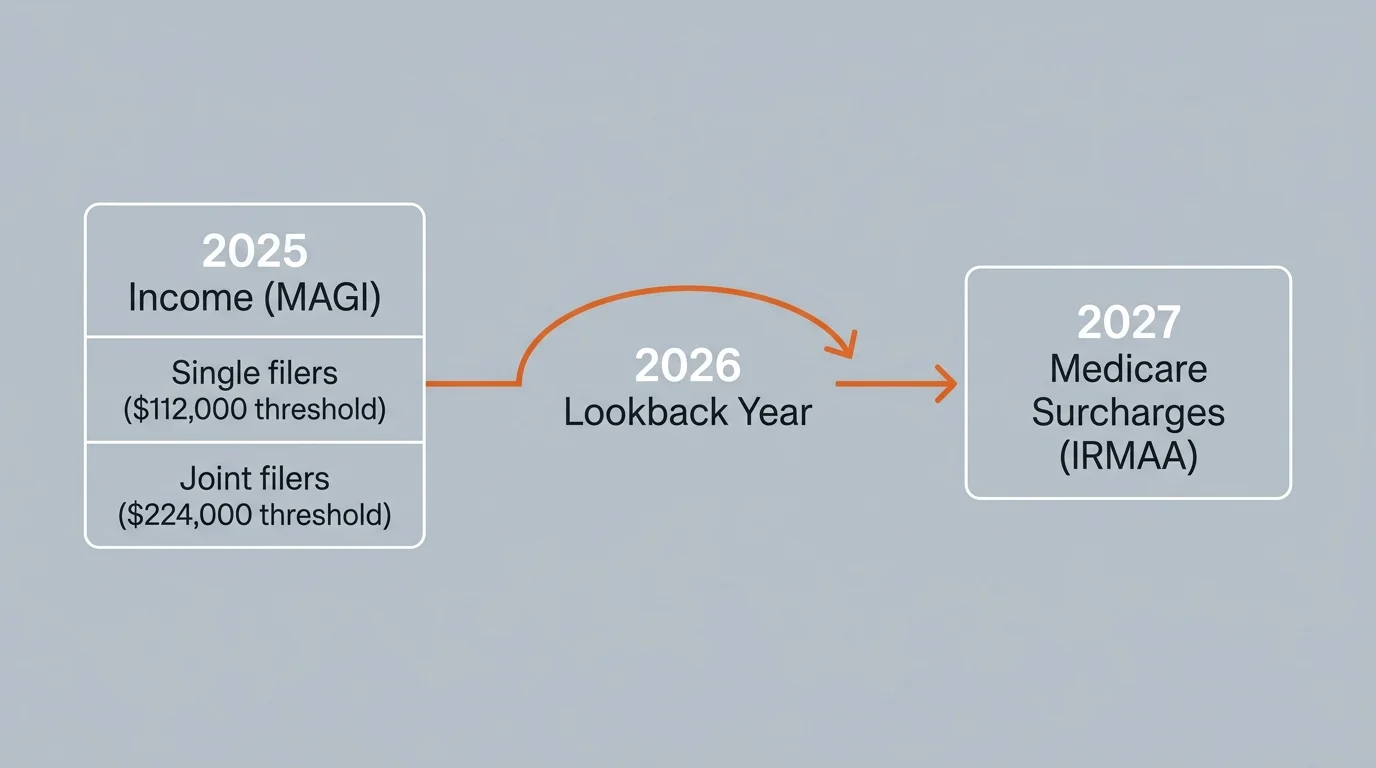
Many Medicare beneficiaries do not realize that their current tax decisions determine their healthcare costs two years down the road. The Income-Related Monthly Adjustment Amount, commonly known as IRMAA, uses a strict two-year lookback period. Consequently, federal agencies examine your 2025 Modified Adjusted Gross Income, or MAGI, to establish your specific Medicare Part B and Part D premium rates for 2027. If your 2025 earnings exceed specific federal thresholds, you will pay a monthly surcharge on top of the standard premium rate.
For 2027, projected IRMAA surcharges begin at approximately $112,000 in 2025 MAGI for individual tax filers and $224,000 for married couples filing jointly—an upward index from $109,000 and $218,000 in 2026. Standard Part B premiums cover approximately 25 percent of the program’s operational costs, but IRMAA surcharges progressively shift higher-income beneficiaries’ financial responsibility to between 35 percent and 85 percent of total program costs across five distinct income tiers. Data reveals that approximately 7 percent of Medicare beneficiaries—representing roughly 4.5 to 5 million individuals—pay these higher income-adjusted surcharges annually.
It is equally important to understand how statutory protections apply to different income levels across the country. Federal law includes a Hold Harmless provision that prevents net Social Security benefit checks from decreasing due to a standard Part B rate hike; however, this protection does not apply if you pay IRMAA surcharges or pay your premiums through direct billing. The Social Security Administration administers these adjustments automatically, which means an unexpected bump in your 2025 income—such as selling real estate, converting a traditional IRA into a Roth IRA, or taking large capital gains—can trigger substantial surcharge tiers in 2027 without prior warning.

Actionable Strategies to Manage Your Healthcare Costs
Navigating potential premium surcharges does not mean you are powerless over your future expenses. By adopting proactive financial strategies, engaging in preventive care, and understanding administrative appeals, you can maintain firm control over both your health outcomes and your personal budget.
1. Optimize Your Modified Adjusted Gross Income
Managing your MAGI requires careful coordination between your income distributions and tax planning strategies throughout the calendar year. To keep your 2025 income below key IRMAA threshold steps, consider utilizing Qualified Charitable Distributions if you are age 70½ or older. Qualified Charitable Distributions allow you to transfer funds directly from a traditional IRA to a qualified charity, satisfying required minimum distributions without counting the funds as taxable income. Additionally, balancing tax-deferred withdrawals with Roth IRA distributions or taxable account capital gains allows you to meet your daily living expenses without artificially inflating your MAGI into a higher Medicare surcharge bracket.
2. Leverage Preventive Care to Lower Overall Out-of-Pocket Costs
Investing time in proactive, preventative healthcare reduces long-term clinical costs and protects your health. Medicare Part B covers a wide range of preventive services at no additional out-of-pocket cost, including annual wellness visits, cardiovascular screenings, diabetes management training, and cancer screenings. Utilizing these benefits regularly helps clinical teams detect potential health issues before they require complex, expensive treatments or emergency room interventions. Research published by the Centers for Disease Control and Prevention highlights that preventive health strategies significantly decrease chronic disease burden and minimize catastrophic health expenditures over a person’s lifespan.
3. Prepare for Life Event Appeals Using Form SSA-44
If your household income drops significantly in 2026 or 2027 due to a major life change, you do not have to settle for surcharges based on an outdated 2025 tax return. The Social Security Administration provides a formal mechanism to request a redetermination using Form SSA-44. Qualifying life-changing events include retirement, work reduction, marriage, divorce, the loss of income-producing property, or the loss of pension income. Submitting proper documentation promptly allows federal officials to recalculate your Medicare premiums based on your current, lower income rather than your prior earnings history.
4. Align Lifestyle Choices with Long-Term Wellbeing
Proactive metabolic health practices, balanced nutrition, and consistent physical movement serve as direct investments in your financial security. Working with healthcare professionals, such as a registered dietitian nutritionist or a physical therapist, helps you manage chronic conditions like hypertension or diabetes effectively. Minimizing prescription reliance through sustainable lifestyle modifications reduces your reliance on tier-three or specialty drugs under Medicare Part D, ultimately lowering your annual out-of-pocket medical expenses.

Perspectives from Healthcare and Financial Professionals
Integrating financial strategy with clinical care creates a far more resilient approach to aging and wellbeing. Medical and financial professionals increasingly emphasize that physical health and financial stability operate as interdependent components of overall quality of life. Resources from the National Institute on Aging consistently show that proactive planning reduces psychological stress, which directly benefits cardiovascular health and cognitive function as you age.
Dr. Elena Rostova, a preventive medicine physician and clinical health consultant, emphasizes that financial surprises often derail patient compliance with care plans. When patients face unexpected increases in healthcare premiums or prescription costs, they sometimes delay necessary doctor visits or compromise on medication adherence. By anticipating premium changes and understanding your IRMAA status two years in advance, you eliminate financial anxiety and create space to focus entirely on physical vitality, proper nutrition, and active living.
Financial planner Marcus Vance echoes this sentiment from a holistic wealth perspective. He notes that clients who treat Medicare planning as an active part of their wellness routine experience far fewer disruptions during retirement. Coordinating tax strategies with healthcare budgeting ensures that unexpected medical bills or premium surcharges never compromise your ability to afford healthy foods, exercise programs, or rewarding personal experiences.
Frequently Asked Questions About Medicare 2027 Brackets
How do I know if my income triggers an IRMAA surcharge for 2027? The Social Security Administration reviews your 2025 tax return, specifically examining your Modified Adjusted Gross Income. If your 2025 MAGI exceeds approximately $112,000 for single filers or $224,000 for joint filers, you will receive an initial determination notice in late 2026 outlining your 2027 premium surcharges. Reviewing your 2025 tax documents with a tax professional helps you identify your bracket early and prepare accordingly.
What happens if my income dropped significantly after the 2025 tax year? If you experienced a qualifying life-changing event—such as retirement, marriage, divorce, or reduced work hours—that lowered your income after 2025, you can file Form SSA-44 with the Social Security Administration. Providing evidence of your lower income allows officials to adjust your 2027 premiums to match your current financial reality rather than relying on outdated tax returns.
Does the Hold Harmless provision protect everyone from Part B premium increases? No, the Hold Harmless rule only protects beneficiaries whose standard Part B premiums are automatically deducted from their Social Security benefits and whose net monthly benefit would decrease due to a premium hike. This provision does not apply to individuals paying IRMAA surcharges, new Medicare enrollees, or those paying premiums through direct billing.
How do Part D drug plan surcharges interact with Part B IRMAA brackets? IRMAA surcharges apply to both Part B medical coverage and Part D prescription drug coverage using the exact same MAGI income brackets. If your 2025 income places you in an IRMAA bracket for Part B, you will also pay a mandatory monthly surcharge on top of your plan’s base Part D premium, paid directly to Medicare rather than your drug plan provider.
Taking Your First Steps Toward Healthcare Security
Managing your healthcare journey effectively involves making informed decisions long before official bills arrive in your mailbox. Take a quiet moment today to review your estimated 2025 Modified Adjusted Gross Income alongside your overall financial roadmap. Reflect on whether your current withdrawal strategy or recent financial transactions might unintentionally nudge you into a higher Medicare premium tier for 2027. Reach out to a qualified financial planner, tax advisor, or healthcare navigator to evaluate your current setup. Taking one proactive step today ensures that your health and wealth remain aligned for years to come.









Leave a Reply