

You might attribute that subtle morning stiffness in your fingers or a dull ache in your knees after a short walk to simple aging, but these quiet changes often signal the onset of arthritis. Catching these early arthritis symptoms early gives you a crucial window to protect your joint cartilage, reduce inflammation, and preserve your mobility for years to come. Today, over 53 million U.S. adults live with doctor-diagnosed arthritis, a number projected to reach 78 million by 2040. Understanding how subtle knee arthritis symptoms and arthritis in hands signs present allows you to make targeted lifestyle shifts and seek timely medical care before permanent joint damage takes hold.
Science Snapshot: Understanding Early Joint Degeneration
Arthritis is not a single disease; rather, it encompasses more than 100 conditions affecting joints and surrounding tissues. Osteoarthritis remains the most prevalent form, currently affecting roughly 33 million U.S. adults. According to recent Centers for Disease Control and Prevention data, 21.3% of all American adults carry a formal doctor-diagnosed arthritis condition. While joint degradation becomes more common as you age, early warning signs often emerge earlier than you might expect.
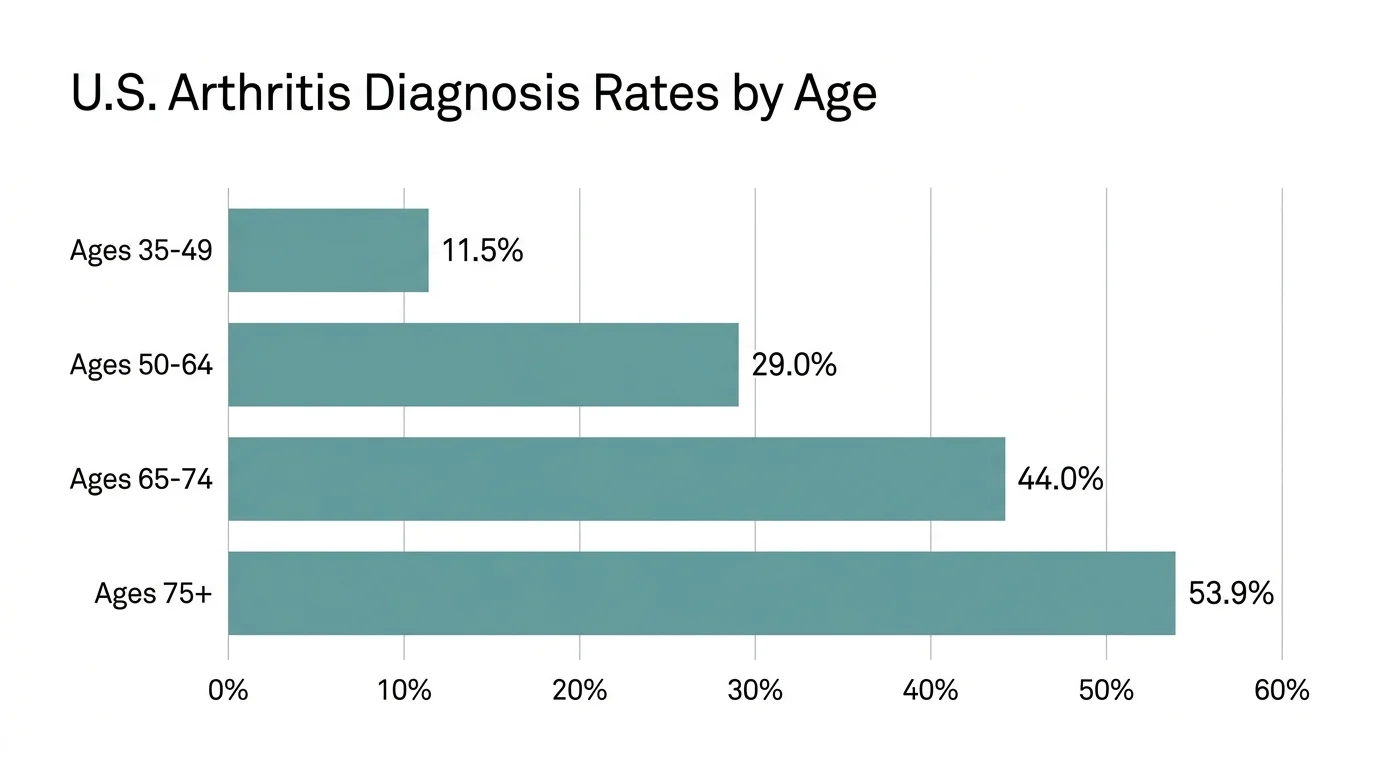
Prevalence figures scale dramatically across age brackets. Data shows that 11.5% of adults aged 35 to 49, 29.0% of those aged 50 to 64, 44.0% of individuals aged 65 to 74, and 53.9% of adults aged 75 and older live with diagnosed joint conditions. Early structural changes—such as micro-tears in hyaline cartilage, mild synovial inflammation, and subtle bone remodeling—frequently precede obvious structural damage on X-rays by several years. Recognizing these physiological shifts early allows you to implement non-invasive therapies when your joint tissue retains its highest capacity for adaptation.
8 Early Warning Signs of Hand and Knee Arthritis
Identifying signs of arthritis in its primary stages requires paying close attention to minor physical discomforts that persist over weeks. Because your hands and knees perform complex, high-frequency mechanical work every day, they often showcase the initial red flags of joint wear and systemic inflammation.
1. Subtle Morning Stiffness That Lingers
You may awaken and notice that your fingers feel rigid or that bending your knees to step out of bed requires extra effort. In early osteoarthritis, this morning stiffness generally dissipates within 30 minutes as movement warms the synovial fluid. If the stiffness persists for longer than an hour, it may point toward systemic inflammatory conditions like rheumatoid arthritis. Monitoring how long your joints take to move freely each morning provides valuable diagnostic context for your physician.
2. Deep, Dull Aches After Routine Activity
Unlike the acute pain of a muscle strain, early arthritis manifests as a persistent, deep ache within the joint structure itself. You might feel a throbbing sensation at the base of your thumb after opening jars or typing; similarly, your knees may ache after climbing stairs or standing during grocery shopping. This discomfort occurs because thinning cartilage offers less cushioning, transferring mechanical shock directly to subchondral bone nerve endings.
3. Joint Crepitus: Popping, Crunching, or Grating Sounds
Audible or tactile crunching, popping, and crackling inside your knee or hand joints—known medically as crepitus—often signals changes in cartilage texture. As smooth articular cartilage roughens, joint surfaces no longer glide effortlessly past one another. While harmless gas bubbles cause occasional painless joint popping, persistent crepitus accompanied by mild soreness indicates early cartilage breakdown that warrants attention.
4. Localized Swelling and Warmth Around the Joint
Mild, intermittent swelling around your knuckles or knee caps suggests that your synovial membrane is producing excess fluid in response to irritation. You might notice that your rings feel tighter on certain days or that your knee cap appears slightly puffy after prolonged walking. The surrounding skin may also feel faintly warm to the touch, reflecting early localized inflammatory activity inside the joint capsule.
5. Decreased Range of Motion and Flexibility
You might realize you can no longer form a tight fist without discomfort or fully extend your leg when standing straight. Early joint changes reduce joint space and cause mild capsular tightening, restricting your full arc of motion. You can track this subtle loss of flexibility by comparing the mobility of both hands or assessing how comfortably you sink into a gentle squat.
6. Loss of Grip Strength and Fine Motor Precision
Arthritis in hands signs often surface during delicate daily tasks. You might find yourself dropping light objects, struggling to turn keypads, or experiencing unexpected hand fatigue while gripping the steering wheel. Weakness in the thumb’s basal joint—the carpometacarpal joint—directly impacts your pinch strength, making routine tasks feel unnaturally cumbersome.
7. Joint Instability or Knee “Giving Way”
A sudden feeling that your knee is going to buckle or yield under your weight is a distinct early sign of joint surface degradation and reflex muscle inhibition. When early cartilage wear alters joint mechanics, your brain sends inhibitory signals to the quadriceps muscles to protect the joint, causing temporary instability during walking, stair climbing, or pivoting.
8. Bony Enlargements and Nodule Development
In the early-to-intermediate stages of hand osteoarthritis, small bony outgrowths called osteophytes may form around your finger joints. Knobbly swellings on the end joints of your fingers (Heberden’s nodes) or middle joints (Bouchard’s nodes) represent your body’s attempt to stabilize the joint by adding bone tissue. In knees, early osteophytes can make the inner joint line feel firm and enlarged upon touch.

Strategy Pillars: Proactive Management for Hand and Knee Health
Discovering warning signs gives you an extraordinary advantage; you can immediately adopt holistic habits that slow degeneration, protect cartilage, and preserve your daily independence. Addressing joint health requires a comprehensive strategy encompassing physical conditioning, anti-inflammatory nutrition, ergonomic adjustments, and medical partnership.
Pillar 1: Targeted Movement and Joint Load Management
Physical activity acts as natural medicine for your joints, provided you choose the right modalities. Low-impact movement stimulates synovial fluid circulation, which bathes cartilage in vital nutrients and oxygen. Focus on building strength in the muscles surrounding your joints—such as your quadriceps, hamstrings, and hand intrinsic muscles—to act as built-in shock absorbers. Tailored movement strategies published by the Arthritis Foundation guidelines highlight how non-weight-bearing exercises like swimming, stationary cycling, and targeted range-of-motion routines preserve joint space without causing excess wear.
Pillar 2: Anti-Inflammatory Nutrition and Hydration
Your daily diet directly influences systemic inflammatory pathways. Shifting toward a Mediterranean-style pattern—emphasizing extra virgin olive oil, fatty fish rich in omega-3 fatty acids, leafy greens, berries, and nuts—helps downregulate pro-inflammatory cytokines that accelerate cartilage degradation. Maintaining optimal hydration is equally critical, as water constitutes roughly 80% of healthy joint cartilage. Evidence curated by the National Institute of Arthritis and Musculoskeletal and Skin Diseases suggests that managing systemic inflammation through balanced nutrition protects soft tissues surrounding affected joints.
Pillar 3: Mindset, Rest, and Ergo-Adaptive Living
Chronic stress elevates cortisol levels, triggering systemic inflammation and heightening your perception of pain. Integrating mindfulness practices, breathwork, and structured sleep hygiene into your daily routine calms your nervous system and speeds cellular repair. Additionally, adopting simple ergonomic changes protects your joints from micro-trauma. Swap narrow pens for wide-grip utensils, use compression sleeves on stiff knees during long walks, and leverage lever-style door handles to minimize hand strain.
Pillar 4: Early Medical Intervention and Diagnostic Care
Partnering early with a primary care physician, physical therapist, or rheumatologist allows you to establish a baseline evaluation before significant tissue damage occurs. Comprehensive medical care includes physical examinations, targeted imaging like magnetic resonance imaging or ultrasound, and selective blood tests to screen for inflammatory markers such as C-reactive protein or rheumatoid factor. Reviewing the latest American College of Rheumatology clinical recommendations ensures you receive evidence-based interventions tailored precisely to your diagnostic profile.

Real Voices: Expert Insights on Early Prevention
Leading clinical experts emphasize that early symptom recognition completely transforms patient outcomes. Physical therapists frequently observe that patients who seek care at the first sign of knee stiffness or grip weakness consistently maintain higher functional mobility over a ten-year period compared to those who wait for severe pain. Targeted quadriceps strengthening can reduce knee joint stress significantly, serving as a powerful preventative intervention.
Similarly, integrative rheumatologists stress the psychological and biological benefits of proactive care. When you view early symptoms as an invitation to overhaul your systemic lifestyle—rather than as an inevitable decline—you experience dramatic reductions in joint inflammation. Combining early medical evaluation with customized lifestyle adaptations yields the most durable, long-term protection for delicate hand and knee structures.
Frequently Asked Questions About Early Arthritis
How can I tell the difference between osteoarthritis and rheumatoid arthritis in my hands?
Osteoarthritis typically affects specific finger joints, such as the distal joints near your fingernails and the base of your thumb, causing stiffness that lasts under 30 minutes in the morning. Rheumatoid arthritis, an autoimmune condition, usually presents symmetrically in both hands, affects the middle finger joints and knuckles, and causes morning stiffness lasting well over an hour along with systemic fatigue. Because treatment pathways differ significantly, consulting a doctor for specialized diagnostic testing is essential.
Can early knee arthritis symptoms be reversed completely?
While lost articular cartilage cannot naturally regenerate completely, early functional symptoms—such as stiffness, swelling, and mild pain—can be mitigated so effectively that you become virtually symptom-free. Through targeted quadriceps strengthening, weight management, anti-inflammatory nutrition, and physical therapy, you can halt progression and restore fluid, comfortable joint mechanics. Early proactive management offers your best opportunity to protect existing cartilage structures.
Is exercise safe when my hands or knees feel stiff and painful?
Yes, gentle exercise is generally beneficial and crucial for joint nutrition, but you must choose joint-friendly activities. Low-impact movements like swimming, water aerobics, stationary cycling, and warm water hand stretches keep joints lubricated without excessive impact. If you experience sharp or severe pain during movement, stop immediately and consult a physical therapist or physician to modify your exercise program safely.
What natural supplements actually support joint health in early-stage arthritis?
Several natural compounds offer research-backed benefits for early joint discomfort, including omega-3 fatty acids, curcumin from turmeric, and collagen hydrolysate. These compounds help modulate inflammatory pathways and support connective tissue health. However, supplement efficacy varies widely by individual, making it important to discuss any new supplement regimen with your healthcare provider to avoid interactions with existing medications.
Taking Your First Step Toward Joint Preservation
Taking control of your joint health does not require a complete lifestyle overhaul overnight. Start today by choosing one manageable action step—such as scheduling a consult with your primary care provider, taking a daily 15-minute low-impact walk, or swapping out processed snacks for anti-inflammatory alternatives. Take a moment to reflect: which subtle signal have your hands or knees been sending you recently, and what single supportive step will you take today to listen and respond? Global health initiatives, including World Health Organization health reports, underscore that long-term healthy aging depends on the proactive daily choices you make right now.








Leave a Reply