
You spot blood on the toilet paper or feel cramps in your lower belly, and your first instinct is to blame hemorrhoids or lunch. Usually minor gut troubles pass quickly, yet brushing off lingering symptoms can delay an important check.
Colorectal cancer often grows silently for years, and diagnoses are rising rapidly among adults under age 50. Recognizing key colorectal cancer warning signs empowers you to ask for the right test instead of waiting.
This guide explains seven symptoms you should never ignore, how doctors separate harmless conditions from cancer, and which screening or diagnostic steps fit your situation. The information below is educational and supports—rather than replaces—care from your clinician.
Why Colorectal Cancer Signs Are Easy to Miss—and Why Age Matters
Your digestive tract handles stress, infections, dietary shifts, and mild inflammation every week. Because everyday stomach upset feels familiar, early colon cancer symptoms blend right into normal life until they refuse to fade.
Most colorectal cancers begin as small, noncancerous growths called polyps that develop slowly over 10 to 15 years. During those early years, polyps rarely press on nerves or block stool, so you usually feel completely fine.
Once a tumor grows large enough to bleed or narrow the bowel, symptoms finally appear. Even then, busy adults frequently assume the culprit is irritable bowel syndrome, food intolerance, or simple aging.
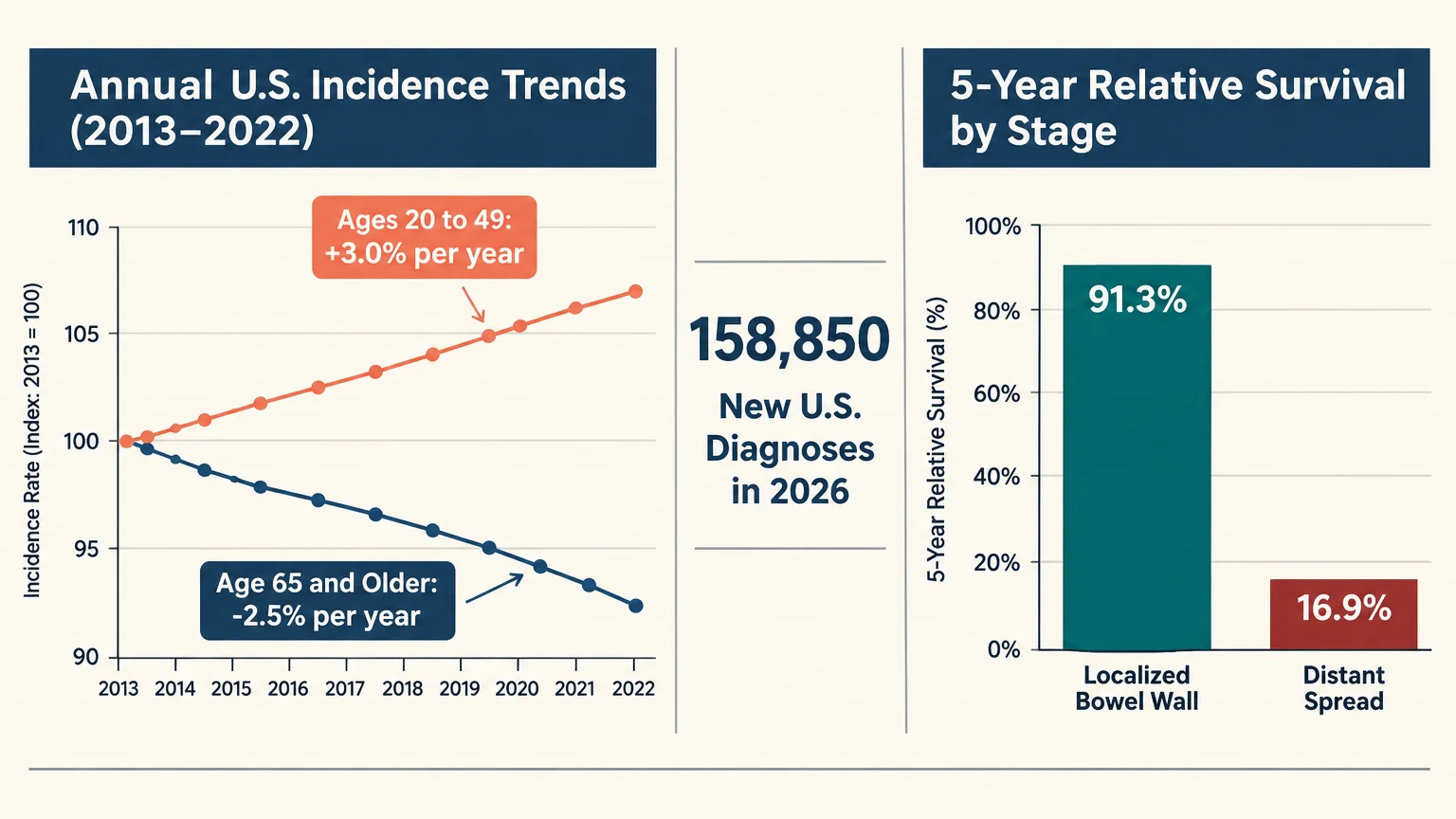
That delay carries real stakes across the United States. The American Cancer Society estimates 158,850 new U.S. colorectal cancer diagnoses in 2026—including 108,860 colon cancers and 49,990 rectal cancers—along with 55,230 deaths.
For decades, older adults carried the main burden of this disease, and overall rates dropped as screening expanded. Recently, however, a University of Chicago analysis of national data published in NEJM Evidence showed overall U.S. incidence ticked up from 36.7 to 38.3 per 100,000 between 2022 and 2023.
Younger adults face the sharpest shift. Between 2013 and 2022, colorectal cancer incidence fell 2.5% per year in adults 65 and older, yet climbed 3% per year in ages 20 to 49.
Today, colorectal cancer ranks as the leading cause of cancer death among U.S. adults younger than 50. Nearly half of all new U.S. cases—45%—now occur under age 65, while roughly 1 in 10 cases occur before age 50.
In March 2026, the American College of Surgeons warned that bowel symptoms in younger adults are frequently dismissed as hemorrhoids or constipation. Meanwhile, three in four colorectal cancers in adults under 50 are diagnosed after the disease has already spread beyond the colon.
Paying close attention to your body changes that trajectory regardless of your birth year. When doctors find colorectal cancer while it remains localized inside the bowel wall, five-year relative survival reaches 91.3%, compared with 16.9% after distant spread.
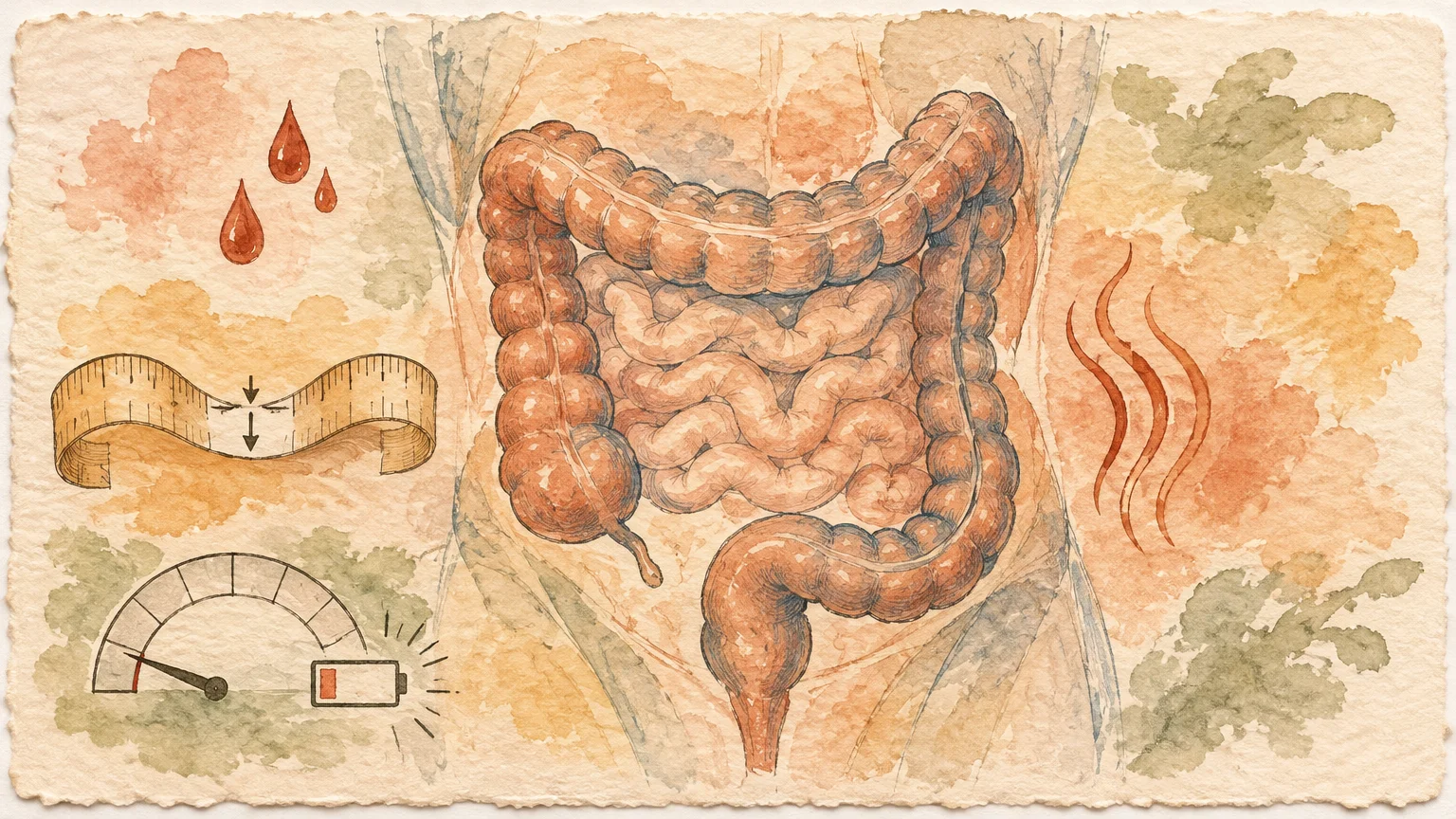
The 7 Colorectal Cancer Warning Signs Many People Ignore
No single symptom proves you have cancer, because benign digestive problems cause most stomach and bathroom changes. However, any new sign that lingers beyond a short illness deserves a conversation with your doctor.
1. Rectal Bleeding or Bright Red Blood in the Toilet
Seeing bright red streaks on toilet paper, drops in the bowl, or blood coating your stool is one of the most common red flags. Many people immediately assume they have hemorrhoids and buy over-the-counter cream without telling a doctor.
Benign anorectal conditions—primarily hemorrhoids and tiny skin tears called anal fissures—do account for roughly 75% to 79% of rectal bleeding diagnoses. Hemorrhoids affect about half of adults over age 50 and drive up to four million U.S. medical visits every year.
Still, primary care studies find that 2.5% to 3.4% of adults who seek care for rectal bleeding are diagnosed with colorectal cancer. Even when you have a known history of hemorrhoids, a tumor higher in the rectum can bleed at the exact same time.
Clinical care pathways treat new or worsening bleeding visible in stool or the toilet most days for more than two weeks as high-risk. Never rely on guesswork to sort out rectal bleeding causes—ask a clinician to examine the area and discuss whether you need a colonoscopy.
2. Persistent Changes in Your Bowel Habits
Everyone experiences an occasional bout of loose stool after travel or sluggish digestion during a stressful week. A warning sign emerges when your normal bathroom rhythm shifts noticeably and stays off track for more than a few days.
Watch for new diarrhea lasting more than three days, new constipation with fewer than three bowel movements per week, or alternating swings between the two. You should also pay attention if your stools suddenly look consistently thin, flat, or ribbon-like.
As a tumor grows inward along the colon lining, it leaves less room for solid waste to pass through comfortably. That physical bottleneck changes stool shape, traps gas, or forces liquid stool around a partial blockage.
If adjusting your water intake and fiber does not restore your baseline pattern within a week or two, schedule an appointment. Bring specific dates and descriptions so your doctor understands how far your habits shifted from normal.
3. A Lingering Urge That Never Feels Relieved
Doctors call the persistent sensation of needing a bowel movement—even right after you finish—tenesmus. You might sit on the toilet repeatedly, strain lightly, and pass nothing or only a tiny amount of mucus or stool.
People often mistake this frustrating pressure for incomplete constipation or mild pelvic tension. Yet tenesmus frequently develops when a growth sits low in the rectum, irritating nearby nerves that signal fullness to your brain.
Rectal cancer now accounts for roughly one in three—32%—of all colorectal cancer diagnoses in the United States. Because rectal tumors sit close to the exit of your digestive tract, pressure and urgency often appear earlier than severe pain.
Track how often you return to the bathroom within an hour of a bowel movement. Telling your doctor clearly that your bowel never feels empty helps pinpoint whether a rectal exam or scope is overdue.
4. Ongoing Abdominal Cramping, Pain, or Bloating
Gas, sharp cramps, or a heavy, swollen belly can stem from lactose intolerance, celiac disease, or trapped air. What separates a concerning symptom from routine indigestion is persistence without a clear dietary trigger.
When a colon tumor partially blocks the passage of stool and gas, intestinal muscles squeeze harder to push contents forward. Those strong contractions produce recurring cramps, dull aches, or uncomfortable fullness after small meals.
Pay attention if pain wakes you at night, settles consistently in one spot, or resists antacids and gentle movement. Severe, sudden pain paired with vomiting or an inability to pass gas requires urgent evaluation because a complete blockage can become an emergency.
Keeping a simple one-week log of meals alongside pain episodes gives your clinician valuable clues. If discomfort outlasts normal stomach bugs, push for a thorough physical exam rather than cycling through random over-the-counter pills.
5. Unexplained Fatigue and Hidden Iron-Deficiency Anemia
Feeling exhausted after poor sleep or a demanding workweek makes sense, yet bone-deep weakness that lingers for weeks demands investigation. In colorectal cancer, persistent fatigue often traces back to iron-deficiency anemia rather than simple burnout.
Tumors on the right side of the colon—where stool is still mostly liquid—often ooze tiny amounts of blood slowly over months. Because that blood mixes deeply into liquid waste and breaks down before leaving your body, you may never see red streaks in the bowl.
Over time, steady blood loss drains your red blood cells and iron stores, leaving muscles and organs short on oxygen. You might notice shortness of breath on stairs, pale skin, dizziness, or a racing heartbeat during light chores.
Health systems such as UC San Diego Health note that low iron on a routine blood panel is sometimes the very first or only clue of a right-sided colon tumor. If a blood test reveals unexplained iron-deficiency anemia—especially in men or postmenopausal women—ask whether you need a diagnostic colonoscopy, not just iron pills.
6. Unintended Weight Loss Without Changing Your Routine
Dropping pounds effortlessly can feel tempting to ignore, yet doctors consider unexplained weight loss a major systemic alarm. Clinically, the threshold that triggers concern is losing at least 5% of your body weight—or about 10 pounds—over 6 to 12 months without trying.
For a 180-pound adult, losing nine pounds without cutting calories or adding workouts warrants a prompt checkup. Cancer cells consume significant energy, trigger inflammatory chemicals that blunt your appetite, and disrupt how your gut absorbs nutrients.
Sometimes people eat less without realizing it because mild bloating or early fullness makes regular meals uncomfortable. Weighing yourself once a month during periods of gut trouble gives you objective numbers instead of relying on how your jeans fit.
Bring your weight history to your medical visit, especially if weight loss pairs with fatigue or bowel changes. Objective numbers move your appointment quickly toward targeted testing.
7. Dark, Tarry, or Unusually Colored Stools
Not all blood from the digestive tract stays bright red by the time it reaches the toilet. When bleeding happens higher up in the colon, stomach acids and gut bacteria break down red blood cells, turning stool dark brown, maroon, or sticky black.
Many people dismiss dark stools after eating blueberries, licorice, bismuth stomach remedies, or daily iron supplements. While food and pills frequently darken waste temporarily, genuine digested blood looks unusually thick, tarry, and foul-smelling.
Once you pause bismuth products or dark foods, harmless color changes clear up within two or three days. If dark or black stools continue—or show up alongside dizziness and weakness—contact a healthcare provider promptly.
A simple stool exam or endoscopic procedure checks quickly whether upper colon bleeding is taking place. Waiting weeks to see if stool lightens on its own lets silent blood loss compound.
Understanding Causes, Risk Factors, and How Doctors Diagnose It
Colorectal cancer develops when cells lining your colon or rectum pick up genetic mutations that allow uncontrolled growth. Most cases occur sporadically over time, shaped by aging, environment, and lifestyle rather than a single inherited gene.
Across a lifetime, roughly 1 in 25 U.S. men and 1 in 26 U.S. women—about 3.9%—receive a colorectal cancer diagnosis. Worldwide, the World Health Organization reports colorectal cancer makes up roughly 10% of all cancer cases and ranks second in cancer deaths.
Several clear factors raise your personal odds and shape when you should start colorectal cancer screening. Having a first-degree relative—a parent, sibling, or child—with colorectal cancer or an advanced polyp doubles to quadruples your risk.
Long-standing inflammatory bowel diseases such as ulcerative colitis or Crohn’s colitis also increase cellular turnover in the colon lining. Race and geography matter too, reflecting unequal access to timely prevention and care.
According to American Cancer Society data, Alaska Native individuals experience the highest colorectal cancer incidence and death rates globally—more than double U.S. White rates. Among larger U.S. racial groups, Black adults face both the highest mortality rate and the second-highest incidence.
Diagnostic Testing vs. Routine Screening
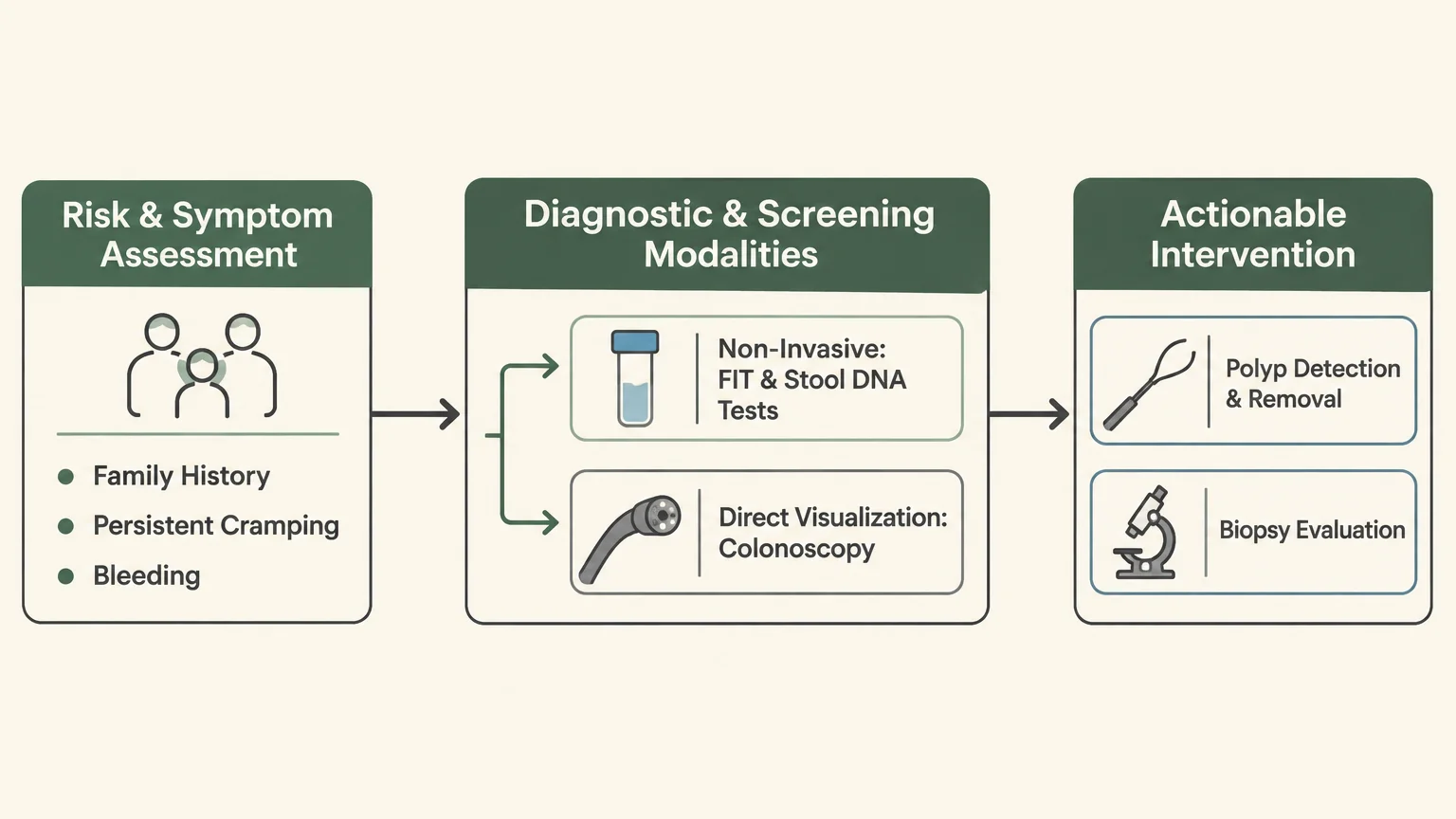
Knowing which test to ask for hinges on one vital rule: screening tests are strictly for adults who feel completely well. If you already notice rectal bleeding, unexplained anemia, or persistent bowel changes, skip at-home stool kits and request a diagnostic colonoscopy.
During a colonoscopy, a gastroenterologist guides a thin, flexible camera through your entire colon while you rest comfortably under sedation. The exam typically takes 30 to 60 minutes and lets the doctor spot tumors, biopsy suspicious spots, and remove precancerous polyps on the spot.
For adults at average risk without symptoms, both the U.S. Preventive Services Task Force and the American Cancer Society recommend starting screening at age 45 and continuing through age 75. Between ages 76 and 85, you and your clinician should decide together based on overall health and prior results, while screening after age 85 is discouraged.
If you have a first-degree relative diagnosed with colorectal cancer, guidelines call for starting colonoscopy at age 40—or 10 years earlier than your relative’s age at diagnosis, whichever comes first—and repeating every five years. Never wait until age 45 if family history puts you in a higher-risk group.
Comparing 2026 Screening Options
When you have zero symptoms and average risk, several approved screening tools fit different schedules and comfort levels. A visual colonoscopy every 10 years remains the gold standard because it prevents cancer by removing polyps before they turn malignant.
If you prefer a non-invasive start at home, annual stool tests such as FIT or high-sensitivity guaiac tests check tiny samples for hidden microscopic blood. Multitarget stool tests, recommended every three years, look for both hidden blood and abnormal DNA or RNA shed by polyps and tumors.
In its May 2026 guideline update, the American Cancer Society named next-generation multitarget stool DNA—Cologuard Plus, which showed 94% cancer sensitivity in the BLUE-C study—and multitarget stool RNA, ColoSense, among preferred three-year stool options. Other visual exams, including CT colonography and flexible sigmoidoscopy, run on five-year schedules.
The May 2026 update also added the Shield blood test every three years strictly as a non-preferred fallback for adults who refuse stool tests and colonoscopy. In the ECLIPSE trial, the blood test caught about 83% of colorectal cancers—only 55% to 65% of Stage I cancers—and just 13% of advanced precancerous lesions.
Whatever non-colonoscopy test you pick, remember one non-negotiable step: any abnormal stool or blood result requires a timely follow-up colonoscopy, ideally within six months. Without that follow-up scope, screening remains unfinished.
The Centers for Disease Control and Prevention estimates that 68% of colorectal cancer deaths could be prevented if every eligible adult stayed current on screening. Right now, over 20 million eligible Americans—roughly one in three—are behind, including nearly two-thirds of adults ages 45 to 49.

The Colorectal Cancer Treatment Landscape
If diagnostic biopsies confirm colorectal cancer, your care team orders imaging scans—such as CT or pelvic MRI—along with blood and tumor marker tests to determine the exact stage. Treatment depends heavily on whether the tumor sits in the colon or rectum and how deeply it extends.
Surgery serves as the cornerstone treatment for most localized and regional cancers. For very small, early cancers inside a polyp, a specialist can sometimes remove the entire lesion during a colonoscopy.
Larger tumors usually require removing the affected segment of colon or rectum alongside nearby lymph nodes, often through minimally invasive laparoscopic or robotic incisions. Surgeons reconnect healthy bowel ends whenever possible so normal digestion continues.
Depending on stage and lymph node status, medical oncologists often add chemotherapy before or after surgery to lower the chance of microscopic cancer cells returning. For rectal cancers—especially locally advanced cases—teams frequently combine radiation therapy with chemotherapy beforehand to shrink the tumor and protect surrounding pelvic muscles.
Before starting drug therapy, ask your oncologist for comprehensive biomarker and genetic testing on your tumor tissue. Identifying specific markers—such as mismatch repair deficiency or gene mutations like KRAS and BRAF—unlocks targeted therapies and immunotherapies that spare healthy cells far better than traditional chemotherapy alone.
Emerging precision approaches, including circulating tumor DNA blood monitoring after surgery, help teams track microscopic residual disease and tailor follow-up scans. Ask your doctor whether clinical trials offer promising newer combinations suited to your tumor profile.
Safety Notes on Diet, Supplements, and Medications
Supportive nutrition, gentle daily movement, and adequate protein help your body tolerate surgery and recover energy during medical treatment. However, never start herbal remedies, high-dose antioxidants, or colon cleanses on your own during active therapy.
Certain supplements interfere with chemotherapy metabolism, thin your blood before surgery, or worsen treatment-related diarrhea. Always review every vitamin, over-the-counter pain reliever, and herbal product with your oncology pharmacist before taking a single dose.
Likewise, if you are scheduled for a colonoscopy, follow your prep instructions down to the hour—even if fasting feels inconvenient. Poor bowel prep hides flat polyps along the colon wall and forces you to repeat the entire procedure.

Living With Colorectal Cancer, Self-Management, and Caregiver Support
Whether you are awaiting test results, healing from polyp removal, or navigating active treatment, daily organization eases overwhelming uncertainty. Start by keeping one dedicated notebook or phone folder for symptom logs, medication lists, pathology reports, and upcoming questions.
After colon surgery or pelvic radiation, your bowel rhythm often shifts into a new normal with more frequent trips or food sensitivities. Working with an oncology-trained registered dietitian helps you adjust soluble fiber, hydration, and meal timing without unnecessary restriction.
Some rectal cancer patients need a temporary or permanent ostomy bag to reroute waste safely while tissues heal. Certified wound and ostomy nurses teach practical pouch care, skin protection, and clothing tips so you return to travel, swimming, and social life comfortably.
Your care team typically brings together a primary care clinician, gastroenterologist, colorectal surgeon, medical oncologist, radiation oncologist, and nurse navigator. Ask early who serves as your main day-to-day contact when new symptoms or fever pop up after hours.
Caregivers carry vital roles too—from driving home after sedated colonoscopies to jotting down complex treatment instructions during stressful consults. If you care for a loved one, protect your own health by accepting meal trains, using respite help, and staying current on your own preventive screenings.
Emotional weight hits hard at every step, even after clear scans arrive. Connecting with peer mentors through groups like the Colorectal Cancer Alliance patient support network helps both patients and caregivers trade practical tips with people who truly understand.
Frequently Asked Questions
How do I tell the difference between hemorrhoids and colon cancer symptoms?
You cannot reliably separate hemorrhoids from colon cancer based on stool color or bathroom discomfort alone. Benign hemorrhoids commonly cause bright red blood on toilet paper and mild itching, yet tumors higher inside the rectum can trigger identical bleeding.
Because both conditions frequently overlap, clinicians use physical exams and diagnostic colonoscopies rather than symptom checklists to rule out cancer. If bleeding continues beyond two weeks—or pairs with fatigue, weight loss, or narrower stools—schedule a medical visit promptly.
What happens next if a home stool test or blood screening comes back positive?
An abnormal FIT, multitarget stool test, or blood-based screen does not automatically mean you have cancer—it simply flags microscopic blood or tumor markers that require a closer look. Your next essential step is completing a follow-up colonoscopy, ideally within six months.
Skipping or delaying that scope leaves precancerous polyps or early tumors unchecked. Call your doctor’s office right away after receiving a positive result so scheduling teams can book your diagnostic appointment quickly.
Does insurance or Medicare cover a colonoscopy if I have symptoms versus routine screening?
Coverage rules depend closely on whether your exam is preventive screening or diagnostic testing for active symptoms. Under federal rules upheld by the U.S. Supreme Court in June 2025 in Kennedy v. Braidwood, most private plans cover routine USPSTF-recommended screenings—including polyp removal and follow-up colonoscopies after abnormal stool tests—at $0 out-of-pocket.
Medicare Part B also covers average-risk screening colonoscopies every 10 years, high-risk exams every 24 months, FIT, Cologuard Plus, Shield, and follow-up colonoscopies after positive stool or blood tests at $0. However, Medicare patients owe 15% coinsurance if a polyp is removed during a screening colonoscopy, and diagnostic colonoscopies ordered for warning signs carry the Part B deductible plus 20% coinsurance.
Without coverage, a colonoscopy can reach $4,350, while the list price for the Shield blood test sits at $1,495. Before scheduling, ask your doctor’s billing office which procedure code applies and confirm out-of-pocket estimates with your insurer—and note that newer non-USPSTF tests like ColoSense or Shield may carry cost-sharing on some private plans.
What new screening tests and research findings should I watch in 2026?
Updated May 2026 guidelines from the American Cancer Society colorectal cancer resource center expanded non-invasive choices by adding next-generation Cologuard Plus, ColoSense stool RNA testing, and the Shield blood test as a non-preferred fallback. Scientists are also investigating why overall U.S. incidence ticked up in 2023 and why rates continue climbing under age 50.
You can compare official preventive timelines through the U.S. Preventive Services Task Force screening recommendations and explore clinical research updates via the National Cancer Institute colorectal cancer overview. Stay cautious of unproven social media cures and discuss any new test with a board-certified physician.

Taking Your Next Step With Confidence
Listening to quiet changes in your bathroom habits, energy, and weight is one of the smartest investments you can make in your long-term health. Most symptoms turn out to be manageable benign problems, yet catching a polyp or early tumor early saves lives.
Write down what you have noticed, call your primary care doctor or gastroenterologist today, and ask plainly whether you need a diagnostic colonoscopy or routine screening. If you feel brushed aside because of your age, respectfully request a second opinion and review trusted guidance from the Centers for Disease Control and Prevention colorectal cancer guidance so you walk into your next visit prepared.