
You can pay nearly nine times less for the exact same generic prescription simply by changing where you fill it. Comparing pharmacy prices puts real money back into your monthly budget for nutritious groceries and daily peace of mind.
Across the country, older adults face steep out-of-pocket drug costs that vary wildly from one street corner to the next. Checking your options before refilling protects both your health routine and your wallet.
This guide shows where seniors pay least, how 2026 and 2027 Medicare rules work, and which daily habits keep medication costs predictable.
Why Your Pharmacy Choice Shapes Your Budget and Health
The Real Cost of Staying on Track
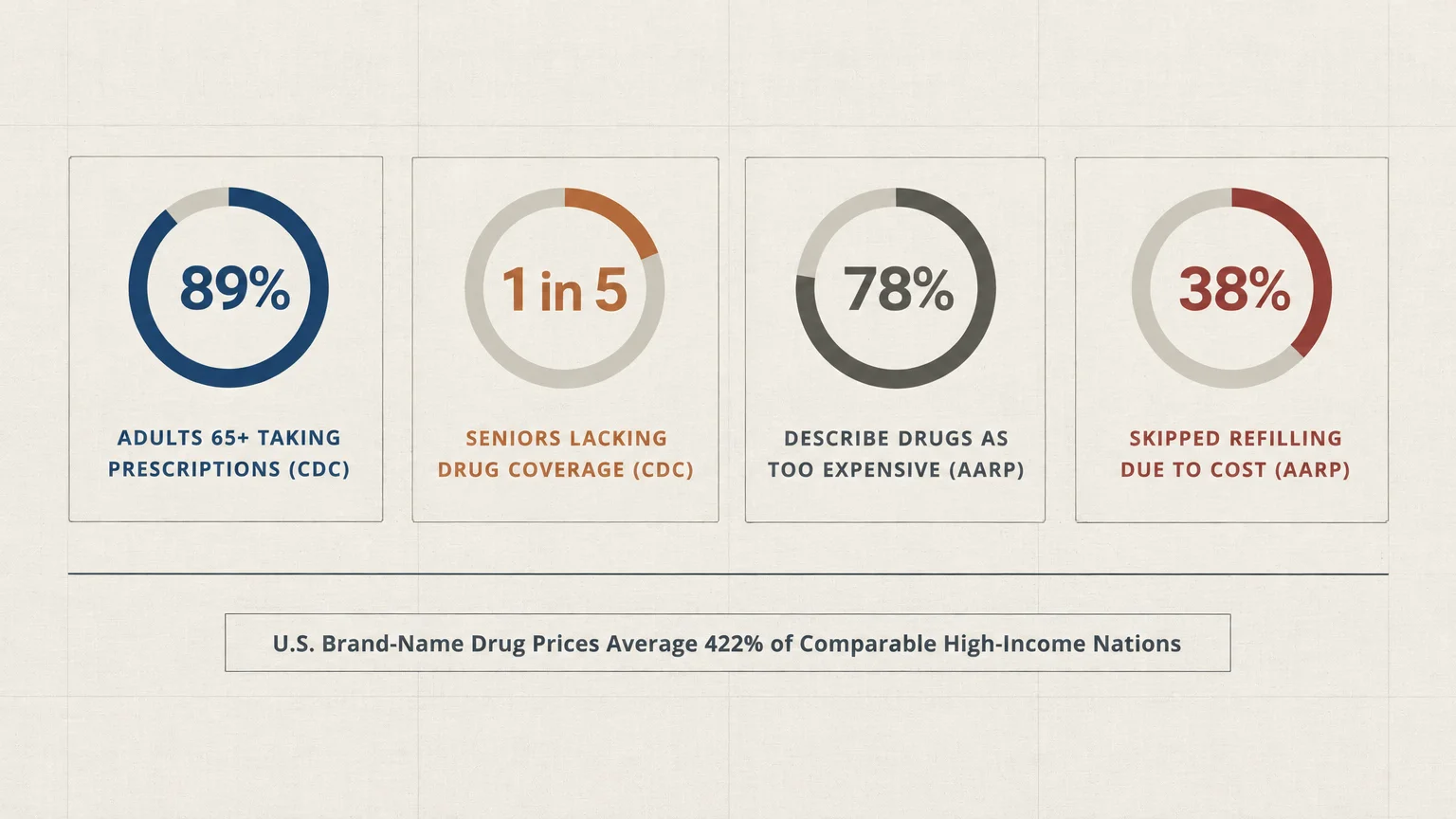
Prescription medications anchor daily health routines for most older adults. According to a September 2024 Centers for Disease Control and Prevention (CDC) report analyzing 2021–2022 National Health Interview Survey data, 89% of U.S. adults aged 65 and older took prescription medication in the past year.
Yet that same CDC report found that roughly 1 in 5 seniors lacked prescription drug insurance coverage. When coverage falls short, pharmacy prices directly dictate whether prescriptions get filled on time.
High counter prices already force painful trade-offs inside millions of households. Per the CDC report, 4% of older adults did not take prescribed medication due to cost, while another 3.4% altered how they took doses to stretch their supply.
Broader polling underscores how widespread this financial pressure feels across retirement budgets. A June 2024 AARP survey found that 78% of adults aged 65 and older describe prescription drugs as too expensive, and 38% say they or someone they know skipped filling a prescription due to cost.
Similarly, a 2024 KFF report noted that nearly 1 in 4 seniors struggle to afford their medications. You feel that squeeze even harder because U.S. drug prices average 278% of prices in comparable high-income countries—and 422% for brand-name medications—per federal and RAND Health Care data.
Total U.S. prescription drug spending reached $378 billion in 2023 according to KFF, while Americans paid a record $98 billion out of pocket in 2024 per the Center for American Progress. Choosing the lowest-cost pharmacy is one of the fastest levers you control to cut your share of that bill.
How Overpaying Disrupts Daily Nutrition and Wellness
As a registered dietitian and wellness coach, I often see pharmacy bills collide directly with grocery budgets. When an unexpected copay drains $150 from your checking account, fresh produce, fatty fish, and high-fiber staples are usually the first items left out of the cart.
Financial stress also undermines restorative sleep, steady blood sugar, and motivation for daily movement. Freeing up even $40 or $80 a month at the pharmacy counter gives you breathing room to prioritize nutrient-dense meals and consistent physical activity.
Treating your pharmacy choice like a smart grocery comparison turns a frustrating errand into an intentional wellness habit. Once you lock in lower, predictable refill costs, staying consistent with both your prescriptions and your kitchen routines becomes far easier.
Pharmacy Price Check: Where Seniors Actually Pay Least
The 8.7-Fold Retail Price Gap for Common Generics
Most people assume every pharmacy charges roughly the same rate for standard generic pills. In reality, walking into the wrong storefront can multiply your out-of-pocket bill several times over for identical ingredients.
A Consumer Reports secret-shopper investigation of 150 pharmacies priced a one-month supply of five common generics: pioglitazone, celecoxib, duloxetine, atorvastatin, and clopidogrel. That single basket exposed an 8.7-fold retail price gap across brick-and-mortar counters.
Costco offered the lowest physical retail price at $105 for all five medications, and independent pharmacies followed closely at $107. Sam’s Club came in third at $153, showing how warehouse pharmacies frequently lead on value.
Traditional retail and grocery counters climbed sharply from there. Walmart priced the five-drug basket at $518, grocery store pharmacies averaged $565, Walgreens charged $752, Rite Aid charged $866, and CVS/Target topped the list at $928.
Online competition undercut every physical counter in that investigation. Verified online pharmacy HealthWarehouse.com charged just $66 for the exact same one-month generic basket.
Big-Box Stores Versus Chains and Independents
Large national datasets confirm that big-box retailers consistently beat traditional drugstore chains on undiscounted cash prices. A national cross-sectional study of 68,353 U.S. pharmacies using GoodRx cash-price data, funded by Arnold Ventures, mapped how prices vary by store type.
Using large chain pharmacies as a 1.00 baseline, the study found that relative undiscounted cash prices for generics dropped to 0.52 at big-box pharmacies. Grocery store pharmacies also beat major chains at an average relative price of 0.82.
However, undiscounted cash rates told a different story at smaller counters. Small chains averaged 1.51 and independent pharmacies averaged 1.61 on undiscounted cash prices, proving that independent stores vary widely unless you ask specifically for cash discounts.
Brand-name medications behave differently from generics at the cash register. In that 68,353-pharmacy study, brand-name cash prices barely budged across pharmacy categories, ranging tightly from 0.97 to 1.06.
This pattern gives you a clear decision rule for your own refill list. Shop big-box, warehouse, or transparent online platforms when paying cash for generics, and lean on insurance design or manufacturer programs when filling pricey brand-name drugs.
Comparing Retail, Warehouse, and Online Discount Programs
Warehouse Clubs: Costco and Sam’s Club
Warehouse clubs remain powerhouse options when you want lower generic pricing, though each follows strict membership and insurance rules. Understanding those rules prevents surprises at the pickup window.
Costco Member Value Pricing, administered with Ventegra, delivers member-only discounts on select prescriptions. However, you cannot combine those member-only discount prices with Medicare, Medicaid, or private insurance.
If you do not hold a Costco membership, check your state’s pharmacy access laws before ruling it out. State laws in many states require warehouse clubs like Costco to let non-members use the pharmacy counter, though non-members pay standard pharmacy prices rather than member-only discounts.
Sam’s Club ties its deepest prescription bargains directly to membership tiers. Both Club and Plus members get select generics starting at $4 for a 30-day supply.
Upgrading to a Sam’s Club Plus membership unlocks even deeper savings on maintenance drugs. Plus members receive hundreds of generic medications for $10 per 90-day supply and select common generics for free.
Grocery and Mass-Market Pharmacies: Walmart and Kroger Updates
You do not always need a club membership to unlock single-digit generic pricing. Walmart’s $4 Prescriptions program covers nearly 100 generic medications with no membership, annual fee, or insurance required.
Eligible medications on Walmart’s list start at $4 for a 30-day supply, with other tiered generics priced at $9 for 30 days or $10 and $24 for 90-day supplies. That predictability works well if you take classic blood pressure, cholesterol, or diabetes generics.
Still, check regional rules before transferring your prescriptions to Walmart. Prices vary in states like California and Minnesota, the program is unavailable in North Dakota, and Walmart Mail Service applies to refills only.
Grocery discount clubs have also shifted significantly in recent years, so avoid relying on outdated brochures. Kroger discontinued its Kroger Rx Savings Club in 2024 and ended its replacement $36-per-year Kroger Health Savings Club on March 6, 2026.
If you previously relied on Kroger’s paid club for discounts, ask the pharmacist to re-run your prescriptions under your Part D plan or a free discount card. Checking current rates ensures you do not quietly revert to high retail cash pricing.
Direct-to-Consumer Online Pharmacies: Cost Plus Drugs and Amazon RxPass
Transparent online pharmacies have reshaped how seniors buy maintenance generics from home. Mark Cuban Cost Plus Drug Company offers over 2,200 mostly generic medications using a flat pricing formula.
You pay the manufacturer cost plus a 15% markup, a $5 pharmacy service fee, and a $5 shipping fee. Ordering a 90-day supply spreads that $5 service fee and $5 shipping charge across three full months.
Cost Plus Drugs does not accept standard Medicare Part D, though it accepts select smaller or employer plans and partnered with Humana’s CenterWell Pharmacy in April 2026. Always compare your total delivered price there—including shipping—against your local counter.
Amazon Pharmacy offers another streamlined option if you already pay for Prime. Since June 18, 2024, Medicare beneficiaries with an Amazon Prime membership ($15 per month) can enroll in RxPass for $5 per month.
RxPass covers unlimited fills of more than 50 eligible common generics with free home delivery. Keep in mind that RxPass does not bill insurance, and Medicaid beneficiaries remain ineligible for the program.
Free Discount Cards and Federal Search Portals
When your neighborhood pharmacy quotes a high retail price, free discount cards can slash the cash rate on the spot. GoodRx, SingleCare, and ScriptSave WellRx work at 54,000 to over 70,000 U.S. pharmacies and advertise up to 80% off retail cash prices.
Paid GoodRx Gold memberships cost $9.99 per month for individuals or $19.99 monthly for families, advertising up to 90% savings across a smaller pharmacy network. Run the math on your exact medications before paying a monthly subscription fee.
You can also check TrumpRx.gov, which launched on February 5–6, 2026 as a cash-pay search and manufacturer-coupon portal rather than a direct seller. On May 18, 2026, the portal expanded to integrate discounts on over 600 generic drugs through Amazon Pharmacy, Cost Plus Drugs, and GoodRx.
Guidance from the HHS Office of Inspector General issued January 27, 2026 permits Medicare and Medicaid enrollees to pay cash through direct-to-consumer platforms when federal programs are not billed. Before choosing cash, however, weigh how that purchase affects your annual Medicare caps.
Navigating Medicare Part D Rules and Negotiated Savings
2026 and 2027 Out-of-Pocket Caps and Deductibles
Medicare Part D covers 56 million older adults and people with disabilities in 2026, including 24.9 million in stand-alone prescription drug plans and 31.4 million in Medicare Advantage drug plans, per a June 2026 KFF analysis of federal data. Average 2026 monthly premiums sit at $36 for stand-alone plans and $8 for Medicare Advantage drug plans.
Major federal protections now place a strict ceiling on what you spend each year on covered Part D prescriptions. According to CMS and Medicare.gov Part D guidance, the annual out-of-pocket cap is $2,100 in 2026, up from $2,000 in 2025.
For 2026, the maximum allowable Part D deductible is $615. In 2027, the annual out-of-pocket cap rises to $2,400, and the maximum allowable deductible rises to $700.
Once your spending reaches that annual cap, you pay $0 out of pocket for covered Part D medications for the rest of the calendar year. Note that monthly plan premiums and Part B medications do not count toward your Part D cap.
The Cash-Versus-Part-D Trap You Must Avoid
Discount cards and direct-to-consumer cash prices can look tempting when you are still working through a $615 or $700 deductible. Yet paying cash without understanding how Medicare tracks spending can cost you more over twelve months.
According to Medicare.gov, using discount cards such as TrumpRx, GoodRx, or SingleCare instead of your Part D plan is not creditable coverage and does not count toward your Medicare deductible or annual out-of-pocket maximum. Every dollar spent outside your Part D claim disappears from your cap progress.
Use a simple annual test to decide when cash wins. If you only take low-cost generics and never approach the $2,100 or $2,400 threshold, paying $4 at Walmart or $10 via a discount card keeps real cash in your pocket.
Conversely, if you take an expensive brand-name medication and expect to hit the annual cap, run every covered refill through your Part D card. Doing so pushes you faster toward $0 refills for the remainder of the year.
If big January or February deductible bills strain your monthly grocery budget, ask your plan about the Medicare Prescription Payment Plan. Available voluntarily at no fee across all Part D plans, it spreads counter costs into predictable monthly bills without lowering your total drug expense.
Insulin Caps, Vaccines, GLP-1 Access, and Negotiated Prices
Federal rules also lock in fixed savings for several high-need therapies. Covered insulin under both Part B pumps and Part D plans is capped at $35 for a one-month supply—or $105 for three months—with no deductible in both 2026 and 2027.
In addition, most Part D-recommended adult vaccines, including shingles shots, carry a $0 copay at in-network pharmacies. Checking your network status before rolling up your sleeve ensures you pay nothing at the clinic or pharmacy counter.
Medicare’s Drug Price Negotiation Program is also cutting underlying prices on blockbuster medications. On January 1, 2026, negotiated maximum fair prices took effect for the first 10 Part D drugs—including Jardiance, Farxiga, and Enbrel—at 38% to 79% discounts off list prices, projected by CMS to save enrollees $1.5 billion in 2026.
On January 1, 2027, negotiated prices take effect for 15 additional Part D drugs—including Ozempic, Wegovy, Rybelsus, Ibrance, Linzess, and Trelegy—at 38% to 85% off 2024 list prices, projected by CMS to save beneficiaries $685 million out of pocket. Federal regulators also selected 15 more drugs in January 2026 for 2028 pricing and finalized a rule on November 5, 2026 to select up to 20 drugs annually starting with 2029.
Watch how your specific plan charges you before expecting an instant drop at the register. Negotiated fair prices directly lower bills for beneficiaries paying percentage coinsurance or sitting in a deductible, whereas flat-copay tiers may show no immediate counter change.
For metabolic health support in 2027, check the Medicare GLP-1 Bridge program as well. According to Medicare.gov, it gives eligible Part D enrollees who meet program criteria access to certain GLP-1 weight-loss drugs for a $50 copayment per one-month supply.
Extra Help: Up to $6,200 in Annual Support
Many older adults qualify for substantial federal prescription aid without realizing their income and savings fit the guidelines. Medicare’s Extra Help program, also called the Low-Income Subsidy, provides an estimated $5,700 per year according to the Social Security Administration—and up to $6,200 annually per Humana estimates.
Extra Help serves individuals and couples up to 150% of the Federal Poverty Level. In 2026, eligibility limits stand at $23,940 in annual income and $18,090 in resources for an individual, or $32,460 in income and $36,100 in resources for a married couple living together.
Approved enrollees generally pay $0 plan premiums up to their state benchmark and a $0 deductible. In 2026, copays cap at just $5.10 for generics and $12.65 for brand-name medications, making it worth checking your eligibility through the Social Security Administration Extra Help portal.
Action Steps: Building a Safe, Cost-Smart Medication Routine
Spotting Unsafe Online Pharmacies Before You Click
Hunting for low prices online requires a sharp eye for safety. The U.S. Food and Drug Administration warns consumers through its FDA BeSafeRx safety hub that rogue online pharmacies often sell counterfeit, expired, or unapproved pills.
Before entering your credit card on an unfamiliar site, run through five quick safety checks. Walk away immediately from any website that sells prescription drugs without requiring a valid prescription from your doctor.
Verify that the pharmacy is licensed both in the United States and by your state board of pharmacy, and confirm that a licensed pharmacist is available to answer questions. Foreign drug manufacturers must also register with the FDA and list products before commercial U.S. importation.
Inspect every mail-order delivery when it lands on your porch. Broken seals, foreign-language labels, missing expiration dates, or advertised prices that seem too good to be true are clear warning signs to contact your pharmacist before taking a single dose.
A Five-Minute Refill Audit Before Every Renewal
You do not need spreadsheets to lock in lower pharmacy bills. Set aside five quiet minutes one week before your next refill runs out and write down every medication name, dosage, and 30-day or 90-day supply count.
First, look up your Part D plan’s negotiated copay at a preferred in-network pharmacy. Next, check the cash price on a big-box list like Walmart’s $4 generics, Costco’s member counter, or Cost Plus Drugs with shipping included.
If a generic costs $15 under insurance but $4 cash, weigh whether you expect to reach your $2,100 or $2,400 Part D cap that year. Ask your prescriber whether switching from 30-day refills to 90-day mail or warehouse fills lowers your per-pill fee.
Finally, ask your doctor during routine checkups if any pricey brand-name drug on your list has an equally effective generic alternative or a lower-tier preferred option on your formulary. One two-minute conversation during an existing appointment can save hundreds of dollars across a calendar year.
Pairing Prescriptions With Daily Meals, Movement, and Mindset
Lower prescription costs work best when paired with daily habits that support your body naturally. As a wellness coach, I encourage you to anchor morning or evening pill routines to existing cues like brewing herbal tea, setting down breakfast, or lacing up walking shoes.
Always ask your pharmacist which medications work best on an empty stomach versus alongside a balanced meal. Pairing fat-soluble supplements or meal-timed drugs with whole foods—such as oats, berries, nuts, or yogurt—protects digestion and reinforces consistent timing.
Reinvest the dollars you save at the pharmacy counter directly into your nutrition routine. You can explore nutrient profiles for budget-friendly staples like beans, leafy greens, and canned wild salmon using the USDA FoodData Central nutrition database.
Mindset matters just as much as meal prep when managing fixed retirement income. Shifting from dread at the pharmacy counter to a scheduled quarterly price check puts you in command of your health spending.
Support Systems That Keep Drug Costs and Habits Steady
Digital Trackers and Pharmacists as Allies
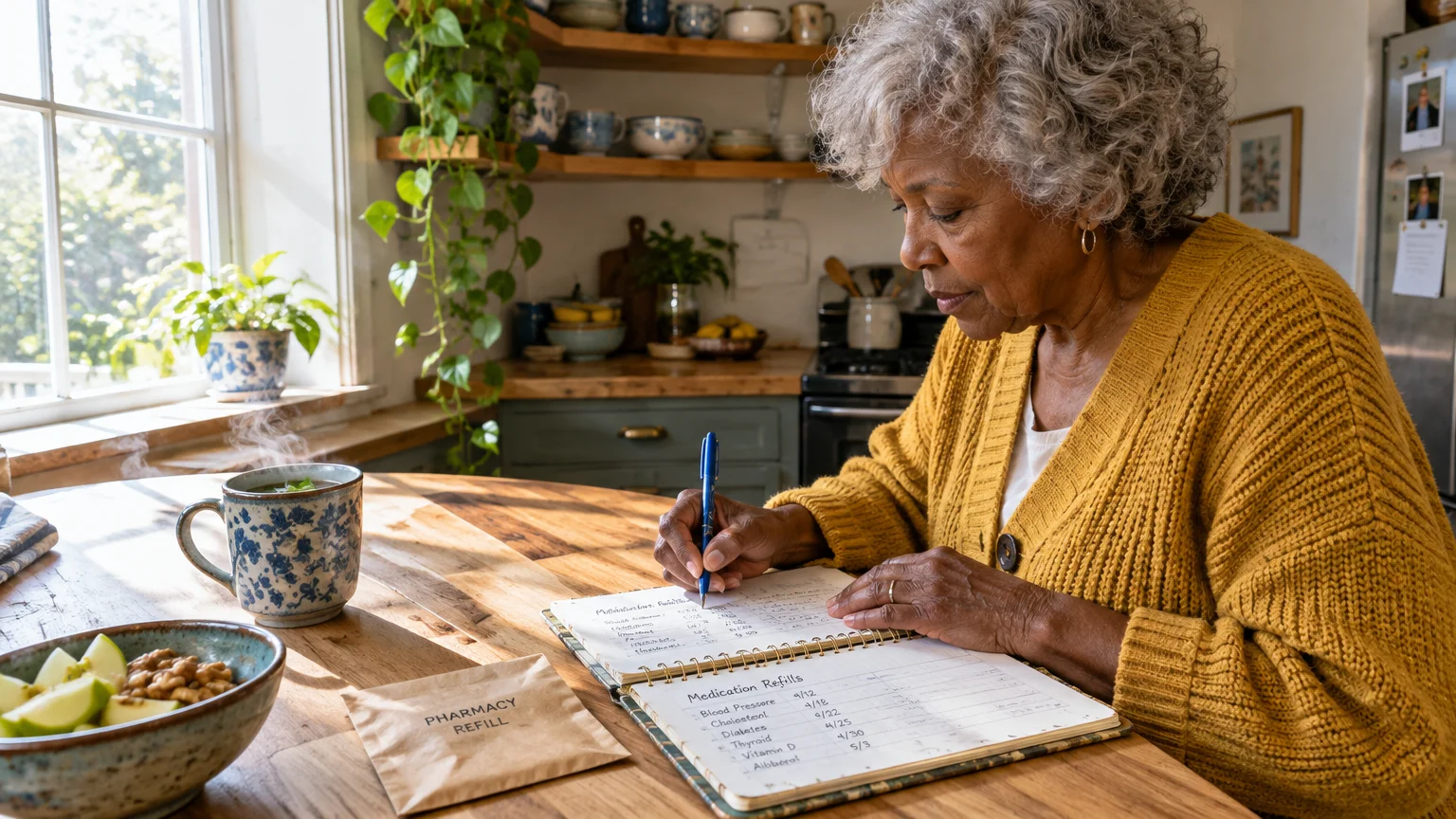
Building sustainable routines gets much easier when you stop relying solely on memory. Use a simple notebook, calendar, or smartphone medication tracker to log both when you take each dose and what you pay at every refill.
Reviewing practical checklists from the National Institute on Aging medication guide helps you prepare smarter questions for appointments. Keeping one updated medication list in your wallet also prevents duplicate prescriptions across specialists.
Your neighborhood or warehouse pharmacist is one of your strongest financial allies if you speak up before the transaction finalizes. Ask politely whether your Part D copay beats their store’s cash price or discount program before your card is charged.
Family Check-Ins and Community Resources
Comparing pharmacy plans alone can feel tedious, so treat it as a shared family wellness check once a year. Invite a spouse, trusted sibling, or adult child to sit beside you during Medicare Open Enrollment to review upcoming formulary changes over coffee.
If you want free, unbiased local guidance, contact your State Health Insurance Assistance Program (SHIP) for one-on-one Part D plan comparisons. Trained counselors walk through your exact medication list without trying to sell a specific insurance policy.
You can even turn pharmacy errands into gentle movement breaks. When picking up refills at a big-box or grocery pharmacy, take two brisk laps around the outer produce and dairy aisles before checking out to add easy steps to your day.
Frequently Asked Questions About Senior Prescription Savings
How much time does it take to compare pharmacy prices each year?
Running an initial comparison on your top three to five medications takes about 20 to 30 minutes once a year during Medicare Open Enrollment. After that, checking a single new prescription against your Part D formulary and a big-box cash price takes less than five minutes.
Should I always use the cheapest cash discount instead of my Medicare Part D plan?
Not always, because cash discounts never count toward your $2,100 (2026) or $2,400 (2027) Part D out-of-pocket cap or your annual deductible. Choose cash for inexpensive generics if you rarely hit your deductible, but bill costly brand drugs through Part D to protect your yearly ceiling.
How can family members help a senior parent lower prescription costs without overstepping?
Start by offering to organize an updated medication list or sit together with a cup of tea to check Extra Help eligibility and local big-box prices. Keeping decisions collaborative respects your parent’s independence while catching expensive auto-renewals or discontinued pharmacy discount clubs.
How do I measure whether switching pharmacies is actually improving my budget and health?
Track two concrete numbers for three months: your total out-of-pocket pharmacy receipts and the number of doses you took on schedule without rationing. Watching both your monthly grocery leeway grow and your missed doses drop to zero confirms your switch is working.
Start With One Small Price-Check Habit This Week
You do not need to overhaul every prescription or switch five stores overnight to capture meaningful savings. Choose just one recurring medication from your cabinet this week and compare your current copay against a warehouse pharmacy, Walmart’s $4 list, or Cost Plus Drugs.
Write down the price difference, pair your daily dose with a glass of water and a nourishing meal, and track how your energy and budget feel over the next seven days. Small, deliberate checks at the pharmacy counter build lasting financial calm and steadier health one refill at a time.