

Navigating specialist care under Medicare can feel overwhelming when unexpected paperwork delays your medical appointments. Understanding your plan’s specific referral guidelines ensures you receive timely treatment while avoiding unexpected medical bills.
Federal regulations establish clear boundaries between plan types, determining whether you need your primary doctor’s formal permission before visiting a specialist. Master these essential guidelines to protect your health and your wallet today.
Whether you manage a chronic condition or require a targeted consultation, knowing the exact rules simplifies your healthcare journey. Here is everything you must know about Medicare specialist referrals.
Understanding Your Coverage: The 9 Core Medicare Referral Rules
1. Original Medicare Never Requires a Primary Care Referral
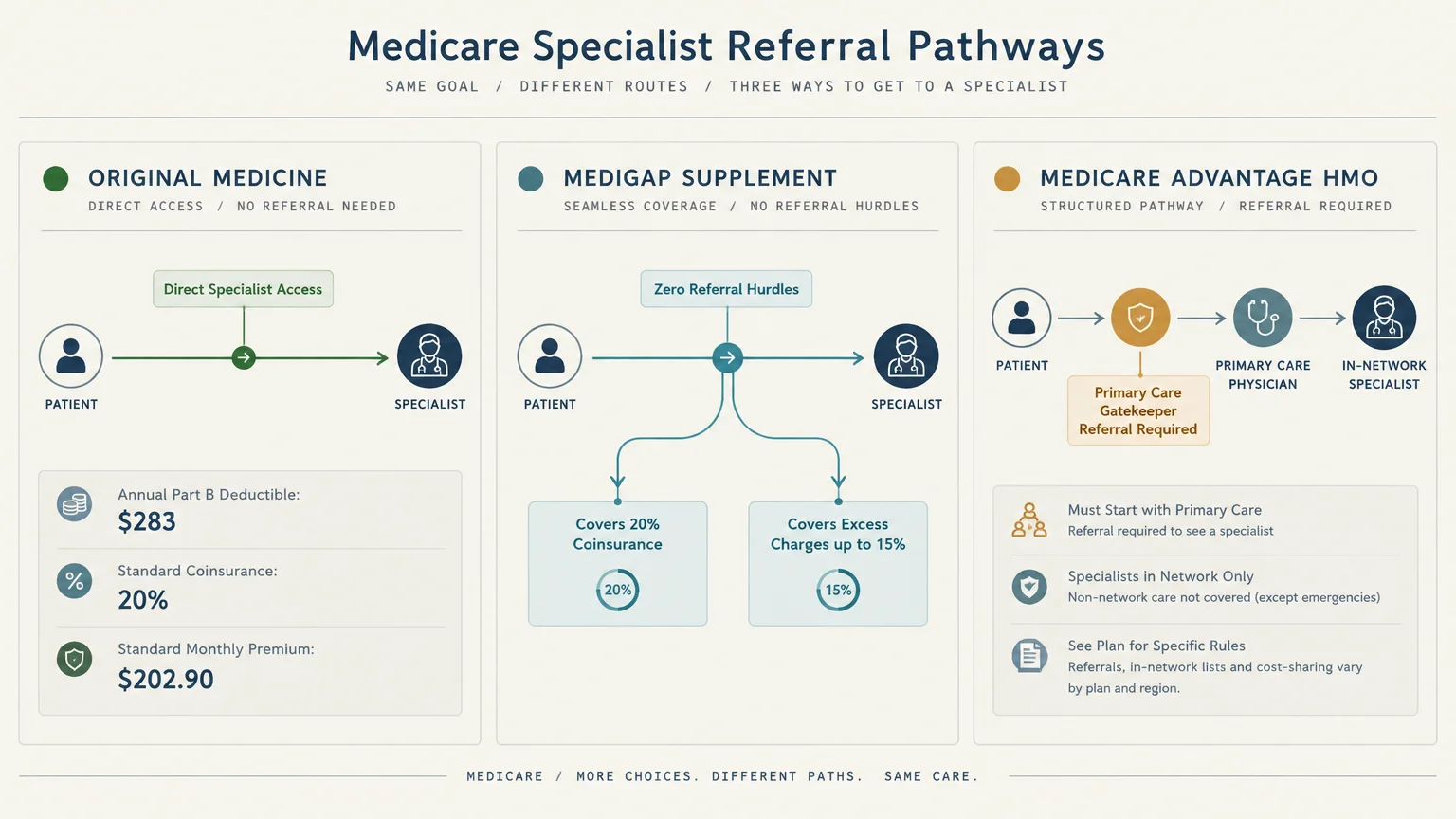
If you enroll in Original Medicare, you possess the freedom to book an appointment with any specialist without consulting your primary doctor first. Part B covers outpatient medical services, including visits to cardiologists, oncologists, orthopedic surgeons, and dermatologists.
You do not need to wait for a written referral slip or an administrative sign-off before scheduling your visit. This direct access allows you to seek second opinions or specialized treatments promptly.
To guarantee coverage, you must verify that your chosen specialist participates in Medicare and accepts Medicare assignment. When a doctor accepts assignment, they agree to charge only the Medicare-approved amount for services.
For outpatient specialist consultations, you must first satisfy the annual Part B deductible of $283. Once you meet this deductible, you pay a standard 20% coinsurance of the Medicare-approved amount.
You also continue paying your standard Part B monthly premium of $202.90 to maintain this continuous coverage. Navigating your care under Original Medicare remains straightforward as long as your provider actively accepts federal program terms.
Some doctors choose to opt out of the Medicare program entirely. If you visit an opted-out specialist, Medicare pays nothing, and supplemental policies cannot contribute.
In those situations, the provider requires you to sign a private contract agreeing to pay all fees out of pocket. Verifying your specialist’s Medicare enrollment status beforehand protects you against unexpected financial obligations.
2. Medigap Plans Honor Your Direct Specialist Access
Medicare Supplement Insurance, commonly known as Medigap, operates directly alongside Original Medicare. Because Medigap follows federal Medicare rules, it never imposes separate referral hurdles on your care.
You can consult any specialist across the United States who accepts Original Medicare assignment. Your Medigap policy simply pays its share of eligible costs after Medicare processes the initial claim.
Depending on your specific Medigap plan letter, your supplemental coverage pays your 20% Part B coinsurance partially or in full. Some Medigap policies also cover the $283 Part B deductible.
Under Original Medicare, some non-participating providers may charge up to 15% above the Medicare-approved rate, known as Part B excess charges. Certain Medigap policies cover these excess charges fully on your behalf.
You never have to file paperwork requesting permission from your supplemental insurer before seeing a medical expert. This seamless coordination makes Medigap an attractive option for people who travel frequently or manage complex conditions.
Always confirm that both your primary physician and your specialist accept Original Medicare before your initial consultation. If the specialist accepts Medicare, your Medigap policy will process the remaining approved balance automatically.
3. Medicare Advantage HMO Plans Enforce Strict Gatekeeper Rules
Health Maintenance Organization (HMO) plans through Medicare Advantage operate under a managed care framework. These plans require you to select an in-network primary care provider who coordinates your healthcare.
If you need specialized diagnostic care or ongoing clinical therapy, your primary doctor must submit a formal referral first. Without this official approval, the HMO plan typically denies coverage entirely.
If you see an in-network specialist without securing an approved referral, you become financially responsible for the full bill. These out-of-pocket costs can quickly accumulate into thousands of dollars for advanced diagnostic tests.
Major commercial insurance carriers have reinforced these administrative structures in recent years. For example, UnitedHealthcare actively expanded strict primary care referral enforcement across its Medicare Advantage HMO and HMO-POS plans.
This policy requires participating patients to obtain verified electronic referrals before receiving outpatient, office-based, or home specialist evaluations. You should always review your annual plan documents to ensure you follow your insurer’s latest protocols.
Some HMO plans feature a Point of Service (HMO-POS) rider that permits out-of-network specialist visits for specific clinical services. However, these POS options almost always carry significantly higher deductible levels and coinsurance requirements.
Building a collaborative working relationship with your primary care physician remains vital within any HMO framework. When your doctor understands your lifestyle goals, they can issue specialist referrals promptly and accurately.
4. Medicare Advantage PPO Plans Permit Direct Specialist Visits
Preferred Provider Organization (PPO) plans offer greater flexibility than HMO arrangements within Medicare Advantage. Under a PPO plan, you generally do not need a referral to schedule an appointment with a specialist.
You can contact an in-network cardiologist, neurologist, or physical therapist directly to secure an appointment. This direct booking process eliminates administrative waiting periods during times when you need prompt clinical evaluations.
PPO plans also permit you to see out-of-network specialists without first securing approval from a primary physician. However, seeking medical care outside the plan’s contracted network triggers substantially higher copayments or coinsurance rates.
Your insurer calculates your cost-sharing at an elevated tier whenever you bypass contracted network doctors. You also face exposure to balance billing if the out-of-network provider does not agree to plan terms.
Although PPO plans eliminate primary doctor referrals, they frequently mandate prior authorization for advanced specialist procedures. High-cost interventions like joint replacements, outpatient surgeries, and MRI scans still require administrative insurer approval.
You will always save money by selecting in-network specialists who have contracted rate agreements with your PPO. Checking the online provider directory helps you avoid unexpected bills while taking advantage of your plan’s flexibility.
5. Special Needs Plans Require Continuous Care Coordination
Medicare Advantage Special Needs Plans (SNPs) serve individuals with specific medical conditions, institutional needs, or dual eligibility for Medicare and Medicaid. Because these plans focus on vulnerable populations, they employ intensive care management models.
Virtually all Special Needs Plans require you to secure a referral from your designated primary doctor before visiting a specialist. This requirement ensures that your core care team monitors every change in your treatment regimen.
Your primary care provider works alongside a dedicated care coordinator to facilitate appointments, monitor lab results, and share clinical notes. This synchronized approach reduces medication conflicts and eliminates redundant diagnostic procedures.
Special Needs Plans categorize enrollees into Chronic Condition SNPs, Dual-Eligible SNPs, or Institutional SNPs. Each category tailors its specialist provider network to address the specific vulnerabilities of its enrolled population.
If you live with chronic conditions like heart failure or diabetes, your SNP referral acts as a clinical roadmap. It guides your specialized interventions while keeping your entire healthcare team fully informed.
Never assume that an existing specialist relationship transfers automatically when enrolling in a Special Needs Plan. You must coordinate with your assigned primary clinic to establish fresh referrals within the plan’s network.
6. Private Fee-for-Service Plans Depend on Provider Agreements
Private Fee-for-Service (PFFS) plans represent another unique branch of Medicare Advantage coverage. These specialized plans determine how much they pay healthcare providers and how much you pay out of pocket.
PFFS plans do not require you to obtain a primary care referral before scheduling a specialist visit. You retain the freedom to choose any state-licensed specialist for your consultations and therapies.
However, an essential condition governs your access under PFFS arrangements. The specialist must actively agree to accept the plan’s specific payment terms and conditions before treating you.
In a PFFS plan, a specialist becomes a deemed provider only after treating you and agreeing to the plan terms for that specific date. A provider can treat you during one visit but decline coverage for a subsequent appointment.
This rule creates potential uncertainty if your physician decides to stop contracting with your insurer. You could find yourself responsible for unexpected medical costs if you fail to reconfirm payment acceptance.
Before every scheduled visit, present your plan information and confirm that the specialist office explicitly accepts the plan’s billing terms. Doing so protects you from sudden out-of-pocket payment demands on the day of care.
7. Federal Law Exempts Preventive Screenings from HMO Referrals
Federal regulations strictly protect your right to certain fundamental preventive services, regardless of your plan structure. Even if you belong to a strict HMO plan, your insurer cannot mandate a specialist referral for routine preventive screenings.
You can schedule your annual screening mammogram directly with an in-network imaging center without waiting for your primary doctor’s permission. The Centers for Disease Control and Prevention emphasizes regular mammography for early disease detection.
Federal Medicare rules also permit women to obtain routine pap smears and pelvic examinations directly from in-network gynecologists without prior referrals. Your plan must cover these established diagnostic wellness services at zero cost to you.
Federal guidelines also protect direct access to colorectal cancer screening examinations and bone density DEXA scans. These preventive measures identify chronic disease markers early, allowing for proactive medical interventions.
Similarly, seasonal flu vaccinations, pneumonia immunizations, and COVID-19 vaccines do not require clinical referrals or office visit authorizations. You can receive these critical preventive shots at any contracted pharmacy or community health clinic.
When performed as strictly preventive screenings by in-network providers, Medicare covers these designated diagnostic assessments without requiring cost-sharing. Always confirm with your clinician’s billing department that they code the encounter as preventive rather than diagnostic.
If an insurer attempts to deny coverage for these specified routine preventive evaluations due to a missing referral, challenge the determination. Federal statutes clearly safeguard direct access to these essential preventive measures.
8. Emergency and Urgent Medical Needs Never Require Referrals
Medical emergencies demand immediate intervention, and federal statutory guidelines reflect this biological reality. No Medicare plan—including the strictest HMO or Special Needs Plan—can legally require a referral for emergency medical care.
If you experience acute chest pain, stroke symptoms, or severe traumatic injury, seek care at the nearest emergency department immediately. You do not need to contact your primary care physician or your insurance carrier beforehand.
Federal law also mandates that emergency services receive coverage at the in-network cost-sharing level, even if the treating hospital remains outside your network. Your insurer cannot penalize you financially for seeking emergency care during a crisis.
Ground ambulance transportation during an acute medical emergency also receives Part B coverage without requiring prior physician referrals. You pay your standard 20% coinsurance after meeting the annual $283 deductible.
This statutory protection extends to urgently needed care when you travel outside your plan’s standard service area. If an unexpected illness arises while away from home, you can visit an urgent care center without prior administrative sign-off.
Be aware of hospital observation status if you require extended monitoring following an emergency department evaluation. Observation care falls under Medicare Part B outpatient benefits rather than Part A inpatient hospital coverage.
Once your acute emergency stabilizes, routine referral guidelines apply again for any subsequent follow-up care. Work closely with your primary physician to organize post-emergency specialist evaluations within your plan’s established network.
9. Approved Referrals Expire and Require Routine Renewals
When your primary doctor approves a referral to an in-network specialist, that authorization does not last indefinitely. In plans requiring referrals, every authorization carries specific limitations regarding duration and visit counts.
Most Medicare Advantage plans issue referrals that remain valid for a specified window, typically spanning 90 days to 1 year. Other plans restrict referrals to a designated number of visits, frequently authorizing between 1 and 3 consultations.
If you require ongoing therapy from an endocrinologist, rheumatologist, or physical therapist, your referral will eventually expire. Attending a specialist visit after an authorization lapses results in claim denials and out-of-pocket financial liability.
Keep a simple handwritten or digital tracking log of every specialist appointment you attend under an active referral. Comparing your log against your insurance portal prevents accidental visits after your authorization limit expires.
Some specialist offices will submit referral renewal requests directly to your primary care clinic on your behalf. However, following up personally ensures the administrative paperwork does not get delayed between medical offices.
Request referral extensions at least two weeks before your authorized visits run out or your approval window closes. Maintaining proactive communication between clinical offices prevents abrupt interruptions in your ongoing medical therapies.

The Science of Coordinated Care: What Research Tells Us
Understanding Medicare referral rules is not merely an exercise in bureaucratic compliance; it profoundly impacts clinical outcomes. Peer-reviewed research highlights significant trade-offs between open provider access and structured primary care coordination.
According to healthcare delivery studies published by the National Institutes of Health, strong primary care coordination correlates with lower hospital readmissions. When a primary physician oversees specialty consultations, patients experience fewer conflicting prescriptions and redundant imaging scans.
A landmark study demonstrated that continuous primary care relationships significantly reduce preventable emergency room visits. Primary doctors synthesize complex specialist recommendations into manageable daily regimens.
Care fragmentation represents a major safety hazard for older adults managing multiple chronic health challenges simultaneously. When patients visit independent specialists without centralized coordination, adverse drug interactions rise significantly.
Interoperability between electronic health records remains an ongoing challenge across fragmented healthcare systems. When health systems fail to communicate, patients experience unnecessary duplicate blood work and conflicting therapeutic guidance.
However, researchers also identify measurable downsides when managed care gatekeeping becomes excessively rigid or administratively burdensome. Unnecessary referral hurdles can introduce dangerous diagnostic delays for time-sensitive conditions like neurological disorders or autoimmune flares.
A balanced care model combines primary care oversight with streamlined specialty access. When clinical systems prioritize rapid communication between providers, patients enjoy better long-term health and reduced administrative stress.
Actively taking control of your medical paperwork bridges these clinical gaps and protects your personal safety. Patients who participate actively in their care transitions report higher satisfaction and better clinical recovery.

Actionable Strategies for Navigating Specialist Care
Streamline Your Paperwork and Prior Authorizations
Many patients confuse clinical referrals with insurance prior authorizations, yet these mechanisms represent distinct administrative processes. A referral is your primary doctor’s medical permission to consult a specialist for a specific condition.
In contrast, a prior authorization represents your insurance plan’s formal financial approval for a specific procedure, therapy, or medication. Even after securing a referral, complex specialist interventions often require secondary prior authorization before treatment begins.
Significant regulatory reforms now protect Medicare Advantage members from prolonged prior authorization delays. Under the Centers for Medicare & Medicaid Services Interoperability and Prior Authorization Final Rule (CMS-0057-F), effective January 1, 2026, strict decision deadlines apply.
Medicare Advantage plans must now decide standard prior authorization requests within 7 calendar days, cutting the previous waiting period in half. For urgent health situations, insurers must deliver a binding authorization decision within 72 hours.
Federal rules also require insurance carriers to supply specific, evidence-based clinical rationales whenever they issue a coverage denial. This transparency equips you and your specialist to file targeted, effective appeals without guessing the insurer’s objections.
If your plan denies an authorization request, federal law grants you five distinct levels of appeal. The CMS-0057-F regulation mandates that insurers explain their denial logic clearly, simplifying your appeal process.
You can also ask your specialist to initiate a peer-to-peer discussion with the insurance plan’s medical director. These physician-to-physician conversations frequently overturn initial authorization denials quickly.
Always ask your specialist’s billing staff whether your upcoming diagnostic procedure or surgery requires formal prior authorization. Confirming authorization numbers before your scheduled appointment shields you from unexpected financial disputes.
Prepare Your Physical Body and Medical Records
Specialist visits yield the best clinical results when you arrive thoroughly organized and physically prepared. Obtain copies of your recent laboratory panels, pathology reports, and digital imaging records from your primary care provider.
Do not assume that independent electronic health record systems communicate seamlessly across different hospital networks. Bringing your own printed copies guarantees that your specialist reviews essential diagnostic history during your initial consultation.
When scheduling advanced consultations, request that the imaging facility burn your scans onto a physical compact disc. Hand-delivering your imaging discs guarantees your specialist can review high-resolution images immediately.
Document a detailed chronological list of your symptoms, noting specific triggers, severity ratings, and daily patterns. This precise clinical snapshot helps the specialist formulate an accurate diagnostic hypothesis efficiently.
Compile a complete inventory of all medications, including exact dosages, over-the-counter supplements, and herbal remedies you consume. Many botanical compounds interact directly with prescription medications, making full transparency critical for your specialist.
Wear comfortable, loose clothing that allows easy physical evaluation of the affected joints, spine, or body regions. Preparing your body and your documents ensures you maximize your limited time with the consulting physician.
Cultivate an Assertive Healthcare Mindset
Advocating for yourself within the modern medical environment requires proactive communication and consistent follow-through. Never assume that a referral transmitted electronically between clinics arrives without administrative delays.
Call your specialist’s scheduling department three business days after your primary doctor initiates a referral request. Verify that the office received the authorization paperwork and that your clinical intake file stands complete.
Identify the name and direct phone extension of the lead referral coordinator at your primary care clinic. Building a polite, professional rapport with this individual accelerates paperwork turnaround when urgent needs arise.
If you encounter administrative pushback, engage directly with your clinic’s patient navigator or nurse care coordinator. These professional advocates specialize in untangling insurance bottlenecks and accelerating appointment schedules for complex cases.
Maintain an organized binder or secure digital folder containing referral reference numbers, clinical summaries, and date-stamped call logs. Documenting the names of insurance representatives you speak with gives you leverage if disputes arise.
Approach your medical appointments as an equal collaborative partner alongside your healthcare providers. Clear self-advocacy transforms healthcare visits from stressful obligations into productive health partnerships.
Remember that you remain the most vital member of your personal healthcare team. Approaching every medical interaction with organized clarity ensures you receive the high-caliber care you deserve under Medicare.

Real Perspectives: Clinicians and Advocates on Medicare Rules
Clinicians and patient advocates frequently observe how administrative confusion disrupts timely patient care. Understanding practical clinical realities helps you anticipate common obstacles before they compromise your ongoing wellness.
Professional guidelines from the American College of Physicians advocate for open channels of communication between general internists and consulting specialists. When clinicians exchange thorough transition notes, patients experience significantly better health outcomes and fewer procedural complications.
Geriatric care managers routinely remind families that referral paperwork requires active oversight rather than passive waiting. Administrative staff handle hundreds of insurance transmissions daily, making personal follow-up calls essential for maintaining appointment momentum.
Experienced medical billing specialists emphasize that verbal assurances from provider reception desks do not guarantee insurance coverage. Always verify that your formal electronic referral appears active within your insurance carrier’s digital member portal.
Clinical practice managers report that missing referral numbers cause more billing disputes than any other administrative oversight. Taking five minutes to verify your authorization status online eliminates hours of billing stress later.
Licensed clinical social workers emphasize that navigating insurance rules requires patience, organization, and emotional resilience. Do not hesitate to enlist a trusted family member to assist with tracking phone calls and authorizations.
Patient advocacy groups emphasize that clear communication between your primary doctor and specialist prevents duplicated blood draws and imaging. Taking ownership of your referral records ensures every doctor operates from the exact same medical baseline.
Frequently Asked Questions About Medicare Specialist Care
What happens if I see a specialist without a required referral?
If your Medicare Advantage plan requires a referral and you visit a specialist without one, your insurer will likely deny the claim. You become personally responsible for the entire financial balance billed by that specialist.
Emergency care remains the only exception to this policy, as federal law protects emergency evaluations from referral requirements. For non-urgent visits, always confirm that your primary doctor’s referral is fully approved before arriving at the specialist’s clinic.
Contact your primary doctor immediately if an unreferred visit occurred due to an administrative mix-up. In some circumstances, providers can submit retroactive referral documentation if the clinical situation warranted urgent care.
How do the new federal prior authorization rules affect my care?
The CMS Interoperability and Prior Authorization Final Rule (CMS-0057-F), effective January 1, 2026, significantly shortens decision timelines for Medicare Advantage plans. Insurers must decide standard requests within 7 calendar days and urgent requests within 72 hours.
Insurers must also provide detailed clinical rationales for any denied requests, making appeals far more actionable. These updated timelines prevent prolonged treatment delays and help you schedule essential specialty therapies with greater confidence.
These expanded federal transparency rules also hold Medicare Advantage insurers accountable through public reporting requirements. Insurers must disclose approval rates and appeal turnaround times annually on their websites.
Can my specialist refer me directly to another specialist?
Under Original Medicare, any physician can recommend another specialist without insurance interference. You simply contact the new provider and confirm they participate in Medicare and accept assignment.
Under Medicare Advantage HMO plans, specialist-to-specialist referrals generally are not valid for insurance reimbursement. Your designated primary care provider must issue the official referral to keep your care covered within network rules.
If your specialist believes you need a different expert, ask them to send their clinical notes directly to your primary physician. Your primary doctor can review the notes and submit the formal referral to your plan promptly.
Does Medicare cover holistic or alternative health specialists?
Medicare provides specific coverage parameters for select integrative modalities while excluding others from standard benefits. For example, Medicare Part B covers manual manipulation of the spine by licensed chiropractors to correct subluxations.
Medicare also covers up to 12 acupuncture sessions within 90 days for chronic low back pain under Part B guidelines. However, coverage requires that your treating provider meet federal credentialing standards and participate in the Medicare program.
Services like naturopathy, routine massage therapy, and functional medicine consultations generally do not qualify for Medicare reimbursement. Always review your plan benefits and consult qualified professionals before pursuing alternative health interventions.
Before booking alternative therapy appointments, always call your insurer to confirm if your specific clinical diagnosis meets coverage criteria. Documenting the representative’s name and reference code protects you against unexpected coverage denials.
Taking Your First Step Toward Seamless Care
Navigating specialist referrals under Medicare does not have to drain your energy or disrupt your wellness routine. By understanding your plan type and tracking key deadlines, you can navigate the medical system with total confidence.
Take a few minutes today to locate your Medicare card and review your plan’s summary of benefits. Determine whether your coverage operates as an Original Medicare plan, an HMO, or a PPO network.
Creating a dedicated healthcare binder is an empowering first step toward mastering your Medicare journey. Storing your insurance summaries, referral letters, and doctor contact lists in one place provides immediate peace of mind.
If you anticipate needing specialized care soon, contact your primary physician’s office to initiate dialogue early. Clarifying referral requirements beforehand protects your health and shields your finances from costly billing surprises.
Always consult your physician and certified Medicare insurance counselors before making major changes to your coverage or treatment plan. Coordinated care works best when you actively steer your own healthcare decisions.
How could an organized approach to your medical paperwork reduce your stress and improve your healthcare experience this month? Reflect on this question as you take charge of your wellness journey today.









Leave a Reply